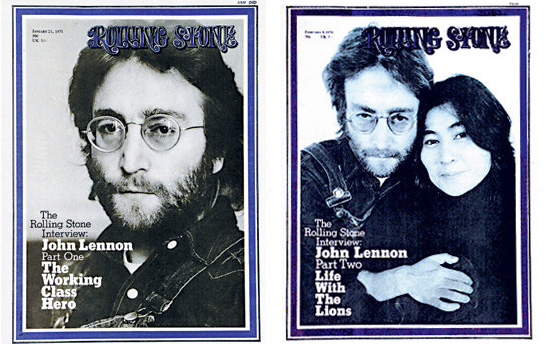
Rolling Stone issues # 74 & 75
(21 Jan & 4 Feb, 1971)
John Lennon: The Rolling Stone Interview
by founding editor Jann S. Wenner
Part One: The Working Class Hero
Part Two: Life With The Lions
This interview took place in New York City on December 8th 1970, shortly
after John and Yoko finished their ‘Plastic Ono Band’ albums in England.
They came to New York to attend to the details of the release of the album,
to make some films, and for a private visit.
Those who aided in the transcribing and editing were Jonathon Cott,
Charles Perry, Sheryl Ball and Ellen Wolper.
 The full 3.5 hours of interview is available as a FREE iTunes podcast at the iTunes music store, courtesy of Rolling Stone magazine.
What do you think of your album?
I think it’s the best thing I’ve ever done. I think it’s realistic and it’s true to the me that has been developing over the years from my life. “I’m a Loser,” “Help,” “Strawberry Fields,” they are all personal records. I always wrote about me when I could. I didn’t really enjoy writing third person songs about people who lived in concrete flats and things like that. I like first person music. But because of my hang-ups and many other things; I would only now and then specifically write about me. Now I wrote all about me and that’s why I like it. It’s me! And nobody else. That’s why I like it. It’s real, that’s all.
I don’t know about anything else, really, and the few true songs I ever wrote were like “Help” and “Strawberry Fields.” I can’t think of them all offhand. They were the ones I always considered my best songs. They were the ones I really wrote from experience and not projecting myself into a situation and writing a nice story about it. I always found that phony, but I’d find occasion to do it because I’d be so hung up, I couldn’t even think about myself.
On this album, there is practically no imagery at all.
Because there was none in my head. There were no hallucinations in my head.
There are no “newspaper taxis.”
Actually, that’s Paul’s line. I was consciously writing poetry, and that’s self-conscious poetry. But the poetry on this album is superior to anything I’ve done because it’s not self-conscious, in that way. I had the least trouble writing the songs of all time.
Ono:
There’s no bullshit.
Lennon:
There’s no bullshit.
The arrangements are also simple and very sparse.
Well, I’ve always liked simple rock. There’s a great one in England now, “I Hear You Knocking.” I liked the “Spirit in the Sky” a few months back. I always liked simple rock and nothing else. I was influenced by acid and got psychedelic, like the whole generation, but really, I like rock and roll and I express myself best in rock. I had a few ideas to do this with “Mother” and that with “Mother” but when you just hear, the piano does it all for you, your mind can do the rest. I think the backings on mine are as complicated as the backings on any record you’ve ever heard, if you’ve got an ear.
Anybody knows that. Any musician will tell you, just play a note on a piano, it’s got harmonics in it. It got to that. What the hell, I didn’t need anything else.
How did you put together that litany in “God”?
What’s “litany?”
“I don’t believe in magic,” that series of statements.
Well, like a lot of the words, it just came out of me mouth. “God” was put together from three songs almost. I had the idea that “God is the concept by which we measure pain,” so that when you have a word like that, you just sit down and sing the first tune that comes into your head and the tune is simple, because I like that kind of music and then I just rolled into it. It was just going on in my head and I got by the first three or four, the rest just came out. Whatever came out.
When did you know that you were going to be working towards “I don’t believe in Beatles”?
I don’t know when I realized that I was putting down all these things I didn’t believe in. So I could have gone on, it was like a Christmas card list: where do I end? Churchill? Hoover? I thought I had to stop.
Ono:
He was going to have a do it yourself type of thing.
Lennon:
Yes, I was going to leave a gap, and just fill in your own words: whoever you don’t believe in. It had just got out of hand, and Beatles was the final thing because I no longer believe in myth, and Beatles is another myth.
I don’t believe in it. The dream is over. I’m not just talking about the Beatles, I’m talking about the generation thing. It’s over, and we gotta — I have to personally — get down to so-called reality.
When did you become aware that that song would be the one that is played the most?
I didn’t know that. I don’t know. I’ll be able to tell in a week or so what’s going on, because they [the radio] started off playing “Look At Me” because it was easy, and they probably thought it was the Beatles or something. So I don’t know if that is the one. Well, that’s the one; “God” and “Working Class Hero” probably are the best whatevers — sort of ideas or feelings — on the record.
Why did you choose or refer to Zimmerman, not Dylan?
Because Dylan is bullshit. Zimmerman is his name. You see, I don’t believe in Dylan and I don’t believe in Tom Jones, either in that way. Zimmerman is his name. My name isn’t John Beatle. It’s John Lennon. Just like that.
Why did you tag that cut at the end with “Mummy’s Dead”?
Because that’s what’s happened. All these songs just came out of me. I didn’t sit down to think, “I’m going to write about Mother” or I didn’t sit down to think “I’m going to write about this, that or the other.” They all came out, like all the best work that anybody ever does. Whether it is an article or what, it’s just the best ones that come out, and all these came out, because I had time. If you are on holiday or in therapy, wherever you are, if you do spend time… like in India I wrote the last batch of best songs, like “I’m So Tired” and “Yer Blues.” They’re pretty realistic, they were about me. They always struck me as — what is the word? Funny? Ironic? — that I was writing them supposedly in the presence of guru and meditating so many hours a day, writing “I’m So Tired” and songs of such pain as “Yer Blues” which I meant. I was right in the Maharishi’s camp writing “I wanna die…”
“Yer Blues,” was that also deliberately meant to be a parody of the English blues scene?
Well, a bit. I’m a bit self-conscious — we all were a bit self-conscious and the Beatles were super self-conscious people about parody of Americans which we do and have done.
I know we developed our own style but we still in a way parodied American music … this is interesting: in the early days in England, all the groups were like Elvis and a backing group, and the Beatles deliberately didn’t move like Elvis. That was our policy because we found it stupid and bullshit. Then Mick Jagger came out and resurrected “bullshit movement,” wiggling your arse. So then people began to say the Beatles were passé because they don’t move. But we did it as a conscious move.
When we were younger, we used to move, we used to jump around and do all the things they’re doing now, like going on stage with toilet seats and shitting and pissing. That’s what we were doing in Hamburg and smashing things up. It wasn’t a thing that Pete Townshend worked out, it is something that you do when you play six or seven hours. There is nothing else to do: you smash the place up, and you insult everybody. But we were groomed and we dropped all of that and whatever it was that we started off talking about, which was what singing … what was it? What was the beginning of that?
Was “Yer Blues” deliberate?
Yes, there was a self-consciousness about singing blues. We were all listening to Sleepy John Estes and all that in art school, like everybody else. But to sing it was something else. I’m self conscious about doing it.
I think Dylan does it well, you know. In case he’s not sure of himself, he makes it double entendre. So therefore he is secure in his Hipness. Paul was saying, “Don’t call it ‘Yer Blues,’ just say it straight.” But I was self-conscious and I went for “Yer Blues.” I think all that has passed now, because all the musicians… we’ve all gotten over it. That’s self-consciousness.
Ono:
You know, I think John, being John, is a bit unfair to his music in a way. I would like to just add a few things… like he can go on for an hour or something. One thing about Dr. Janov, say if John fell in love, you know he is always falling in love with all sorts of things, from the Marharashi to all what not.
[John and Yoko went through four months of intensive therapy with Dr. Arthur Janov, author of ‘The Primal Scream’ (Putnam’s), in Los Angeles, June through September of this year. In October they returned to England, where they made their new albums. “Having a primal,” or “primaling,” is an extremely intense type of re-living/acting-out experience, around which many of Janov’s theories are based.]
Nobody knows there is a point on the first song on Yoko’s track where the guitar comes in and even Yoko thought it was her voice, because we did all Yoko’s in one night, the whole session. Except for the track with Ornette Coleman from the past that we put on to show people that she wasn’t discovered by the Beatles and that she’s been around a few years. We got stuff of her with Cage, Ornette Coleman… we are going to put out “Oldies But Goldies” next for Yoko. I’ll play it again and talk about it later.
Ono:
There is this thing that he just goes on falling in love with all sorts of things. But it is like he fell in love with some girl or something and he wrote this song. Who he fell in love with is not very important, the outcome of the song itself is important. That is very important.
For instance, you have to say that a song like “Well, Well, Well” is connected with Primal therapy or the theory of Primal Therapy.
Why?
The screaming.
No, no. Listen to “Cold Turkey.”
Ono:
He’s screaming there already.
Lennon:
Listen to “Twist and Shout.” I couldn’t sing the damn thing I was just screaming. Listen to it. Wop-Bop-a-loo-bop-a-Wop-bam-boom. Don’t get the therapy confused with the music. Yoko’s whole thing was that scream. “Don’t Worry, Kyoko” was one of the fuckin’ best rock and roll records ever made. Listen to it, and play “Tutti Fruitti.” Listen to “Don’t Worry, Kyoko” on the other side of “Cold Turkey.”
I’m digressing from mine, but if somebody with a rock-oriented mind could possibly hear her stuff, you’ll see what she’s doing. It’s fantastic, you know. It’s as important as anything we ever did, and it is as important as anything the Stones or Townshend ever did. Listen to it, and you’ll hear what she is putting down. On “Cold Turkey” I’m getting towards it. I’m influenced by her music 1000 percent more than I ever was by anybody or anything. She makes music like you’ve never heard on earth.
And when the musicians play with her, they’re inspired out of their skulls. I don’t know how much they played her record later. We’ve got a cut of her from the Lyceum in London, 15 or 20 musicians playing with her, from Bonnie and Delaney and the fucking lot. We played the tracks of it the other night. It’s the most fantastic music I’ve ever heard. They’ve probably gone away and forgotten all about it. It’s fantastic. It’s like 20 years ahead of its time. Anyway, back to mine.
You once said about “Cold Turkey”: “That’s not a song, that’s a diary.”
So is this, you know. I announced “Cold Turkey” at the Lyceum saying, “I’m going to sing a song about pain.” So pain and screaming was before Janov. I mean Janov showed me more of my own pain. I went through therapy with him like I told you and I’m probably looser all over.
Are you less paranoid now?
No. Janov showed me how to feel my own fear and pain, therefore I can handle it better than I could before, that’s all. I’m the same, only there’s a channel. It doesn’t just remain in me, it goes round and out. I can move a little easier.
What was your experience with heroin?
It just was not too much fun. I never injected it or anything. We sniffed a little when we were in real pain. We got such a hard time from everyone, and I’ve had so much thrown at me, and at Yoko, especially at Yoko. Like Peter Brown in our office — and you can put this in — after we come in after six months he comes down and shakes my hand and doesn’t even say hello to her. That’s going on all the time. And we get into so much pain that we have to do something about it. And that’s what happened to us. We took “H” because of what the Beatles and others were doing to us. But we got out of it.
Ono:
You know he really produced his own stuff. Phil is, as you know, well known about as a very skillful sort of technician with electronics and engineering.
Lennon:
But let’s not take away from what he did do, which expended a lot of energy and taught me a lot, and I would use him again.
Like what?
Well, I learned a lot on this album, technically. I didn’t have to learn so much before. Usually Paul and I would be listening to it and we wouldn’t have to listen to each individual sound. So there are a few things I learned this time, about bass, one track or another, where you can get more in and where I lost something on a track and some technical things that irritated me finally. But as a concept and as a whole thing, I’m pleased, yes. That’s about it, really. If I get down to the nitty gritty, it would drive me mad, but I do like it really.
When you record, do you go for feeling or perfection of the sound?
I like both. I go for feeling. Most takes are right off and most times I sang it and played it at the same time. I can’t stand putting the backing on first, then the singing, which is what we used to do in the old days, but those days are dead, you know.
It starts off with bells: why?
Well, I was watching TV as usual, in California, and there was this old horror movie on, and the bells sounded like that to me. It was probably different, because those were actually bells slowed down that they used on the album. They just sounded like that and I thought oh, that’s how to start “Mother.” I knew “Mother” was going to be the first track so…
You said that you wrote most of the songs in California?
Well, actually some of it. Actually I wrote “Mother” in England, “Isolation” in England and a few more. I finished them off in California. You will have to push me if you want more detail. “Look At Me” was written around the Beatles’ double album time, you know, I just never got it going, there are a few like that lying around.
You said that this would be the first “Primal Album.”
When did I say that?
In California. Have you gone off it?
I haven’t gone off it, it is just that “Primal” is like another mirror, you know.
Ono:
He is sort of like any artist, because he really wants to be honest to himself and to the album, I suppose. What he does is just patching up something that is sort of interesting — so-so, or something. He really puts himself in it, his life in it, you know, and so, like when he went to India, he was influenced by the Maharishi.
Lennon:
It’s really like, you know, writers take themselves to Singapore to get the atmosphere. So wherever I am. In that way it is sort of a “Primal” album. It’s like George’s is the first “Gita” album.
Ono:
It’s that relevant. The Primal Scream is a mirror and he was looking at the mirror.
When you came out to San Francisco, you wanted to take an advertisement to say, “This Is It!”
I think that is something people will go through at the beginning of that therapy, because you are so astounded with what you find out about yourself. You think, well, surely this is something, because it happens to you, and this must be the first time that it happened.
And, it was that we wanted to come. I need a reason for going somewhere — otherwise I’m too nervous, so I calm myself. So that was a good way of coming to San Francisco to see you. Then I have an objective: “I’m going to do an act and this is what we are coming to do.” And we settle down and we just talk.
I still think that Janov’s therapy is great, you know, but I don’t want to make it into a big Maharishi thing. You were right to tell me to forget the advert, and that is why I don’t even want to talk about it too much, if people know what I’ve been through there, and if they want to find out, they can find out, otherwise it turns into that again.
You don’t want people to think that this is the single thing to do.
I don’t think anything else would work on me. But then of course, I’m not through with it; it’s a process that is going on. We primal almost daily. You see, I don’t really want to get this big Primal thing going because it is so embarrassing. The thing in a nutshell: primal therapy allowed us to feel feelings continually, and those feelings usually make you cry. That’s all. Because before, I wasn’t feeling things, that’s all. I was blocking the feelings, and when the feelings come through, you cry. It’s as simple as that, really.
Do you think the experience of therapy helped you become a better singer?
Maybe.
Do you think your singing is better on this album?
It’s probably better because I have the whole time to myself, you know. I mean I’m pretty good at home with the tapes. This time it was my album and it used to get a bit embarrassing in front of George and Paul, because we know each other so well. We used to be a bit supercritical of each other, so we inhibited each other a lot. And now I have Yoko there, and Phil there, alternatively and together, who sort of love me so that I can perform better, and I relaxed. I’ve got a whole studio at home now, and I think it will be better next time, because that is even less inhibiting than going to E.M.I. It’s like that, but the looseness of the singing was developing on “Cold Turkey” from the experience of Yoko’s singing. You see, she does not inhibit her throat.
It says on the album that Yoko does wind?
Yes. Well, she plays wind, she played atmosphere. She has a musical ear, and she can produce rock and roll. She can produce me, which she did for some of the tracks. I’m not going to start saying that she did this and he did that. But when Phil couldn’t come at first… you don’t have to be born and bred in rock, she knows when a bass sound is right, and when a guy is playing out of rhythm and when the engineer — she had a bit of trouble — the engineer thinks well, who the hell is this? What does she know about it? So, she did that for me.
“Working Class Hero” sounds like an early Dylan song.
Anybody that sings with a guitar and sings about something heavy would tend to sound like this. I’m bound to be influenced by those, because that is the only kind of real folk music I really listen to. I never liked the fruity Judy Collins and Baez and all of that stuff. So the only folk music I know is about miners up in Newcastle, or Dylan. In that way I would be influenced, but it doesn’t sound like Dylan to me. Does it sound like Dylan to you?
Only in the instrumentation.
That’s the only way to play. I never listen that hard to him.
Did you put in “fucking” deliberately on “Working Class Hero?”
No. I put it in because it fit. I didn’t even realize that there were two in the song until somebody pointed it out. When I actually sang it, I missed a verse which I had to add in later. You do say “fucking crazy”; that is how I speak. I was very near to it many times in the past, but, I would deliberately not put it in, which is the real hypocrisy, the real stupidity.
What is November 5th?
In England it’s the day they blew up the Houses of Parliament so we celebrate by having bonfires every November 5th, Guy Fawkes Day. It just was an ad lib: it was about the third take, and I got to remembering, and it begins to sound like Frankie Laine, you know, when you sing, (sings) “Remember the Fifth of November.” I just broke up, and it went on for about another seven or eight minutes. We started ad libbing and goofing about, but then I cut it there and just exploded, it was a good joke. Haven’t you ever heard of Guy Fawkes? I thought it was just poignant that we should blow up the Houses of Parliament.
Do you get embarrassed sometimes when you hear the album, when you think about how personal it is?
I get embarrassed. You see, sometimes I can hear it and be embarrassed just by the performance of either the music or the statements, and sometimes I don’t. I change daily, you know. Like just before it’s coming out, I can’t bear to hear it in the house or play it anywhere, but a few months before that, I can play it all the time. It just changes all the time.
Sometimes I used to listen to something, Buddy Holly or something, and one day the record will sound twice as fast as the next day. Did you ever experience that on a single? I used to have that: one day “Hound Dog” would sound very slow and one day it would sound very fast. It was just my feeling towards it. The way I heard it. It can do that. That’s where you have to make your artistic judgment to say well, this is the take and this isn’t. That’s the way you have to make the decision: when it sounds reasonable.
“Isolation” and “Hold On John” are rough remixes. I just mixed them on 7 1/2 [ips, a conventional home tape recorder speed] to take home to play and see what else I was going to do with them. Then I didn’t even put them onto 15 [ips — the speed at which professional taping is done], so the quality is a bit off on them.
What is your concept of pain?
I don’t know what you mean, really.
On the song “God” you start by saying: “God is a concept by which we measure our pain…”
Well, pain is the pain we go through all the time, you know. You’re born in pain. Pain is what we are in most of the time, and I think that the bigger the pain, the more gods we need, you know?
There is a tremendous body of philosophical literature about God as a measure of pain.
I never heard of it. You see, it was my own revelation. I don’t know who wrote about it, or what anybody else said, I just know that’s what I know.
Ono:
He just felt it.
Lennon:
Yes, I just felt it. It was like I was crucified, when I felt it. So I know what they’re talking about now.
What is the difference between George Martin and Phil Spector?
George Martin… I don’t know. You see, for quite a few of our albums, like the Beatles’ double albums, George Martin didn’t really produce it. In the early days, I can remember what George Martin did.
What did he do in the early days?
He would translate… If Paul wanted to use violins he would translate it for him. Like “In My Life” there is an Elizabethan Piano solo in it, so he would do things like that. We would say “play like Bach” or something, so he would put 12 bars in there. He helped us develop a language, to talk to musicians.
I was very, very shy, and there are many reasons why I didn’t like very much go for musicians. I didn’t like to have to see 20 guys sitting there and try to tell them what to do. Because they’re all so lousy anyway. So, apart from the early days — when I didn’t have much to do with it — I did it myself.
Why did you use Phil now instead of George Martin?
Well it’s not instead of George Martin. That’s nothing personal against George Martin. He’s more Paul’s style of music than mine. But I don’t know, really… it’s a drag to do both. To go in the recording studio and then you run back and say did you get it?
Did Phil make any special contribution?
Yes, Yes. Phil, I believe, is a great artist and like all great artists he’s very neurotic. But we’ve done quite a few tracks together, Yoko and I, and she’d be encouraging me in the other room and all that, and — at one point in the middle we were just lagging — Phil moved in and brought in a new life. We were getting heavy because we had done a few things and the thrill of recording had worn off a little. So you can hear Spector here and there. There is no specifics, you can just hear him.
I read a little interview with you done when you went to the Rock and Roll Revival over a year ago in Toronto. You said you were throwing up before you went on stage.
Yes. I just threw up for hours until I went on. I even threw up… I read a review in Stone, the one about the film [Toronto Pop, by D.A. Pennebaker] I haven’t seen yet, and they were saying I was this and that. I was throwing up nearly in the number, I could hardly sing any of them, I was full of shit.
Would you still be that nervous if you appeared in public?
Always that nervous, but what with one thing and another, it just had to come out some way. I don’t think I’ll do much appearing, it’s not worth the strain, I don’t want to perform too much for people.
What do you think of George’s album?
I don’t know… I think it’s all right, you know. Personally, at home, I wouldn’t play that kind of music, I don’t want to hurt George’s feelings, I don’t know what to say about it. I think it’s better than Paul’s.
What did you think of Paul’s?
I thought Paul’s was rubbish. I think he’ll make a better one, when he’s frightened into it. But I thought that first one was just a lot of… Remember what I told you when it came out? “Light and easy,” You know that crack. But then I listen to the radio and I hear George’s stuff coming over, well then it’s pretty bloody good. My personal tastes are very strange, you know.
What are your personal tastes?
Sounds like “Wop Bop a Loo Bop.” I like rock & roll, man, I don’t like much else.
Why rock & roll?
That’s the music that inspired me to play music. There is nothing conceptually better than rock and roll. No group, be it Beatles, Dylan or Stones have ever improved on “Whole Lot of Shaking” for my money. Or maybe I’m like our parents: that’s my period and I dig it and I’ll never leave it.
What do you think of the rock and roll scene today?
I don’t know what it is. You would have to name it. I don’t think there’s…
Do you get any pleasure out of the Top Ten?
No, I never listen. Only when I’m recording or about to bring something out will I listen. Just before I record, I go buy a few albums to see what people are doing. Whether they have improved any, or whether anything happened. And nothing’s really happened. There’s a lot of great guitarists and musicians around, but nothing’s happening, you know. I don’t like the Blood, Sweat and Tears shit. I think all that is bullshit. Rock and roll is going like jazz, as far as I can see, and the bullshitters are going off into that excellentness which I never believed in and others going off… I consider myself in the avant garde of rock and roll. Because I’m with Yoko and she taught me a lot and I taught her a lot, and I think on her album you can hear it, if I can get away from her album for a moment.
What do you think of Dylan’s album?
I thought it wasn’t much. Because I expect more — maybe I expect too much from people — but I expect more. I haven’t been a Dylan follower since he stopped rocking. I liked “Rolling Stone” and a few things he did then; I like a few things he did in the early days. The rest of it is just like Lennon-McCartney or something. It’s no different, its a myth.
You don’t think then it’s a legitimate “New Morning”?
No, It might be a new morning for him because he stopped singing on the top of his voice. It’s all right, but it’s not him, it doesn’t mean a fucking thing. I’d sooner have “I Hear You Knocking” by Dave Edmonds, it’s the top of England now.
It’s strange that George comes out with his “Hare Krishna” and you come out with the opposite, especially after that.
I can’t imagine what George thinks. Well, I suppose he thinks I’ve lost the way or something like that. But to me, I’m like home. I’ll never change much from this.
Let’s re-approach that: always the Beatles were talked about — and the Beatles talked about themselves — as being four parts of the same person. What’s happened to those four parts?
They remembered that they were four individuals. You see, we believed the Beatles myth, too. I don’t know whether the others still believe it. We were four guys… I met Paul, and said, “You want to join me band?” Then George joined and then Ringo joined. We were just a band that made it very, very, big that’s all. Our best work was never recorded.
Why?
Because we were performers — in spite of what Mick says about us — in Liverpool, Hamburg and other dance halls. What we generated was fantastic, when we played straight rock, and there was nobody to touch us in Britain. As soon as we made it, we made it, but the edges were knocked off.
You know Brian put us in suits and all that, and we made it very, very big. But we sold out, you know. The music was dead before we even went on the theater tour of Britain. We were feeling shit already, because we had to reduce an hour or two hours’ playing, which we were glad about in one way, to 20 minutes, and we would go on and repeat the same 20 minutes every night.
The Beatles music died then, as musicians. That’s why we never improved as musicians; we killed ourselves then to make it. And that was the end of it. George and I are more inclined to say that; we always missed the club dates because that’s when we were playing music, and then later on we became technically, efficient recording artists — which was another thing — because we were competent people and whatever media you put us in we can produce something worthwhile.
How did you choose the musicians you use on this record?
I’m a very nervous person, really, I’m not as big-headed as this tape sounds, this is me projecting through the fear, so I choose people that I know, rather than strangers.
Why do you get along with Ringo?
Because in spite of all the things, the Beatles could really play music together when they weren’t uptight, and if I get a thing going, Ringo knows where to go, just like that, and he does well. We’ve played together so long, that it fits. That’s the only thing I sometimes miss is just being able to sort of blink or make a certain noise and I know they’ll all know where we are going on an ad lib thing. But I don’t miss it that much.
How do you rate yourself as a guitarist?
Well, it depends on what kind of guitarist. I’m OK, I’m not technically good, but I can make it fucking howl and move. I was rhythm guitarist. It’s an important job. I can make a band drive.
How do you rate George?
He’s pretty good. (Laughter) I prefer myself. I have to be honest, you know. I’m really very embarrassed about my guitar playing, in one way, because it’s very poor, I can never move, but I can make a guitar speak.
I think there’s a guy called Richie Valens, no, Richie Havens, does he play very strange guitar? He’s a black guy that was on a concert and sang “Strawberry Fields” or something. He plays like one chord all the time. He plays a pretty funky guitar. But he doesn’t seem to be able to play in the real terms at all. I’m like that.
Yoko has made me feel cocky about my guitar. You see, one part of me says yes, of course I can play because I can make a rock move, you know. But the other part of me says well, I wish I could just do like B.B. King. If you would put me with B.B. King, I would feel real silly. I’m an artist, and if you give me a tuba, I’ll bring you something out of it.
You say you can make the guitar speak; what songs have you done that on?
Listen to “Why” on Yoko’s album “I Found Out.” I think it’s nice. It drives along. Ask Eric Clapton, he thinks I can play, ask him. You see, a lot of you people want technical things; it’s like wanting technical films. Most critics of rock and roll, and guitarists, are in the stage of the Fifties when they wanted a technically perfect film, finished for them, and then they would feel happy.
I’m a cinema verite guitarist, I’m a musician and you have to break down your barriers to hear what I’m playing. There’s a nice little bit I played, they had it on the back of “Abbey Road.” Paul gave us each a piece, there is a little break where Paul plays, George plays and I played. And there is one bit, one of those where it stops, one of those “carry that weights” where it suddenly goes boom, boom, on the drums and then we all take it in turns to play. I’m the third one on it.
I have a definite style of playing. I’ve always had. But I was over-shadowed. They call George the invisible singer. I’m the invisible guitarist.
You said you played slide guitar on “Get Back.”
Yes, I played the solo on that. When Paul was feeling kindly, he would give me a solo! Maybe if he was feeling guilty that he had most of the “A” side or something, he would give me a solo. And I played the solo on that. I think George produced some beautiful guitar playing. But I think he’s too hung up to really let go, but so is Eric, really. Maybe he’s changed. They’re all so hung up. We all are, that’s the problem. I really like B.B. King.
Do you like Ringo’s record, his country one?
I think it’s a good record. I wouldn’t buy any of it, you know. I think it’s a good record, and I was pleasantly surprised to hear “Beaucoups of Blues,” that song you know. I thought, good. I was glad, and I didn’t feel as embarrassed as I did about his first record.
It’s hard when you ask me, it’s like asking me what do I think of… ask me about other people, because it looks so awful when I say I don’t like this and I don’t like that. It’s just that I don’t like many of the Beatles records either.
My own taste is different from that which I’ve played sometimes, which is called “cop out” to make money or whatever. Or because I didn’t know any better.
I would like to ask a question about Paul and go through that. When we went and saw “Let It Be” in San Francisco, what was your feeling?
I felt sad, you know. Also I felt… that film was set-up by Paul for Paul. That is one of the main reasons the Beatles ended. I can’t speak for George, but I pretty damn well know we got fed up of being side-men for Paul.
After Brian died, that’s what happened, that’s what began to happen to us. The camera work was set-up to show Paul and not anybody else. And that’s how I felt about it. On top of that, the people that cut it, did it as if Paul is God and we are just lyin’ around there. And that’s what I felt. And I knew there were some shots of Yoko and me that had been just chopped out of the film for no other reason than the people were oriented for Englebert Humperdinck. I felt sick.
How would you trace the break-up of the Beatles?
After Brian died, we collapsed. Paul took over and supposedly led us. But what is leading us, when we went round in circles? We broke up then. That was the disintegration.
When did you first feel that the Beatles had broken up? When did that idea first hit you?
I don’t remember, you know. I was in my own pain. I wasn’t noticing, really. I just did it like a job. The Beatles broke up after Brian died; we made the double album, the set. It’s like if you took each track off it and made it all mine and all George’s. It’s like I told you many times, it was just me and a backing group, Paul and a backing group, and I enjoyed it. We broke up then.
Where were you when Brian died?
We were in Wales with the Maharishi. We had just gone down after seeing his lecture first night. We heard it then, and then we went right off into the Maharishi thing.
Where were you?
In Wales. A place called Bangor, in Wales.
Were you in a hotel or what?
We were just outside a lecture hall with Maharishi and I don’t know… I can’t remember, it just sort of came over. Somebody came up to us… the press were there, because we had gone down with this strange Indian, and they said “Brian’s dead” and I was stunned, we went in to him. “What, he’s dead,” and all were, I suppose, and the Marharishi, we went in to him. “What, he’s dead,” and all that, and he was sort of saying oh, forget it, be happy, like an idiot, like parents, smile, that’s what the Maharishi said. And we did.
What was your feeling when Brian died?
The feeling that anybody has when somebody close to them dies. There is a sort of little hysterical, sort of hee, hee, I’m glad it’s not me or something in it, the funny feeling when somebody close to you dies. I don’t know whether you’ve had it, but I’ve had a lot of people die around me and the other feeling is, “What the fuck? What can I do?”
I knew that we were in trouble then. I didn’t really have any misconceptions about our ability to do anything other than play music and I was scared. I thought, “We’ve fuckin’ had it.”
What were the events that sort of immediately happened after Brian died?
Well, we went with Maharishi… I remember being in Wales and then, I can’t remember though. I will probably have to have a bloody primal to remember this. I don’t remember. It just all happened.
How did Paul react?
I don’t know how the others took it, it’s no good asking me… it’s like asking me how you took it. I don’t know. I’m in me own head, I can’t be in anybody else’s. I don’t know really what George, Paul or Ringo think anymore. I know them pretty well, but I don’t know anybody that well. Yoko, I know about the best. I don’t know how they felt. It was my own thing. We were all just dazed.
So Brian died and then you said what happened was that Paul started to take over.
That’s right. I don’t know how much of this I want to put out. Paul had an impression, he has it now like a parent, that we should be thankful for what he did for keeping the Beatles going. But when you look back upon it objectively, he kept it going for his own sake. Was it for my sake Paul struggled?
Paul made an attempt to carry on as if Brian hadn’t died by saying, “Now, now, boys, we’re going to make a record.” Being the kind of person I am, I thought well, we’re going to make a record all right, so I’ll go along, so we went and made a record. And that’s when we made “Magical Mystery Tour.” That was the real…
Paul had a tendency to come along and say well he’s written these ten songs, let’s record now. And I said, “well, give us a few days, and I’ll knock a few off,” or something like that. “Magical Mystery Tour” was something he had worked out with Mal and he showed me what his idea was and this is how it went, it went around like this, the story and how he had it all… the production and everything.
Paul said, “Well, here’s the segment, you write a little piece for that,” and I thought bloody hell, so I ran off and I wrote the dream sequence for the fat woman and all the thing with the spaghetti. Then George and I were sort of grumbling about the fuckin’ movie and we thought we better do it and we had the feeling that we owed it to the public to do these things.
When did your songwriting partnership with Paul end?
That ended… I don’t know, around 1962, or something, I don’t know. If you give me the albums I can tell you exactly who wrote what, and which line. We sometimes wrote together. All our best work — apart from the early days, like “I Want to Hold Your Hand” we wrote together and things like that — we wrote apart always. The “One After 909,” on the “Let It Be” LP, I wrote when I was 17 or 18. We always wrote separately, but we wrote together because we enjoyed it a lot sometimes, and also because they would say well, you’re going to make an album get together and knock off a few songs, just like a job.
Whose idea was it to go to India?
I don’t know… I don’t know, probably George’s, I have no idea. Yoko and I met around then. I lost me nerve because I was going to take me ex-wife and Yoko, but I don’t know how to work it. So I didn’t quite do it.
“Sexy Sadie” you wrote about the Maharishi?
That’s about the Maharishi, yes. I copped out and I wouldn’t write “Maharishi what have you done, you made a fool of everyone.” But, now it can be told, Fab Listeners.
When did you realize he was making a fool of you?
I don’t know, I just sort of saw him.
While in India or when you got back?
Yes, there was a big hullaballo about him trying to rape Mia Farrow or somebody and trying to get off with a few other women and things like that. We went to see him, after we stayed up all night discussing was it true or not true. When George started thinking it might be true, I thought well, it must be true; because if George started thinking it might be true, there must be something in it.
So we went to see Maharishi, the whole gang of us, the next day, charged down to his hut, his bungalow, his very rich-looking bungalow in the mountains, and as usual, when the dirty work came, I was the spokesman — whenever the dirty work came, I actually had to be leader, wherever the scene was, when it came to the nitty gritty, I had to do the speaking — and I said “We’re leaving.”
“Why?” he asked, and all that shit and I said, “Well, if you’re so cosmic, you’ll know why.” He was always intimating, and there were all these right-hand men always intimating, that he did miracles. And I said, “You know why,” and he said, “I don’t know why, you must tell me,” and I just kept saying “You ought to know” and he gave me a look like, “I’ll kill you, you bastard,” and he gave me such a look. I knew then. I had called his bluff and I was a bit rough to him.
Ono:
You expected too much from him.
Lennon:
I always do, I always expect too much. I was always expecting my mother and never got her. That’s what it is, you know, or some parent, I know that much.
You came to New York and had that press conference.
The Apple thing. That was to announce Apple.
But at the same time you disassociated yourselves from the Maharishi.
I don’t remember that. You know, we all say a lot of things when we don’t know what we’re talking about. I’m probably doing it now, I don’t know what I say. You see, everybody takes you up on the words you said, and I’m just a guy that people ask all about things, and I blab off and some of it makes sense and some of it is bullshit and some of it’s lies and some of it is — God knows what I’m saying. I don’t know what I said about Maharishi, all I know is what we said about Apple, which was worse.
Will you talk about Apple?
All right.
How did that start?
Clive Epstein, or some other such business freak, came up to us and said you’ve got to spend so much money, or the tax will take you. We were thinking of opening a chain of retail clothes shops or some balmy thing like that… and we were all thinking that if we are going to have to open a shop, let’s open something we’re interested in, and we went through all these different ideas about this, that and the other. Paul had a nice idea about opening up white houses, where we would sell white china, and things like that, everything white, because you can never get anything white, you know, which was pretty groovy, and it didn’t end up with that, it ended up with Apple and all this junk and The Fool and all those stupid clothes and all that.
What happened to Magic Alex?
I don’t know, he’s still in London.
Did you all really think he had those inventions?
I think some of his stuff actually has come true, but they just haven’t been manufactured — maybe one of them is a salable object. He was just another guy who comes and goes around people like us. He’s all, right, but he’s cracked, you know.
When did you decide to close that down?
I don’t know. I was controlling the scene at the time, I mean, I was the one going in the office and shouting about. Paul had done it for six months, and then I walked in and changed everything. There were all the Peter Browns reporting behind my back to Paul, saying, “You know, John’s doing this and John’s doing that, that John, he’s crazy,” I was always the one that must be crazy, because I wouldn’t let them have status quo.
Well, Yoko and I together, we came up with the idea to give it all away, and stop fuckin’ about with a psychedelic clothes shop, so we gave it all away. It was a good happening.
Were you at the big giveaway?
No, we read it in the papers. That was when we started events. I learned events from Yoko. We made everything into events from then on and got rid of it.
You gave away your M.B.E.?
I’d been planning on it for over a year and a bit. I was waiting for a time to do it.
You said then that you were waiting to tag it to some event, then you realized that it was the event.
That’s the truth.
You also said then that you had another thing you were going to do.
I don’t know what it was.
Do you remember?
Yes, I do. Well, we always had… we always kept them on their toes, during our events period. I don’t know, but we said we had some other surprise for them later. I can’t remember what it was.
Ono:
Probably War Is Over, the poster event.
To go back to Apple and the breakup of the Beatles, Brian died, and one thing and another…
I didn’t really want to talk about all this… go on.
Do you mind?
Well, we’re halfway through it now, so let’s do it.
You said you quit the Beatles first.
Yes.
How?
I said to Paul “I’m leaving.”
I knew on the flight over to Toronto or before we went to Toronto: I told Allen I was leaving, I told Eric Clapton and Klaus that I was leaving then, but that I would probably like to use them as a group. I hadn’t decided how to do it — to have a permanent new group or what — then later on, I thought fuck, I’m not going to get stuck with another set of people, whoever they are.
I announced it to myself and the people around me on the way to Toronto a few days before. And on the plane — Klein came with me — I told Allen, “It’s over.” When I got back, there were a few meetings, and Allen said well, cool it, cool it, there was a lot to do, businesswise you know, and it would not have been suitable at the time.
Then we were discussing something in the office with Paul, and Paul said something or other about the Beatles doing something, and I kept saying “No, no, no” to everything he said. So it came to a point where I had to say something, of course, and Paul said, “What do you mean?” I said, “I mean the group is over, I’m leaving.”
Allen was there, and he will remember exactly and Yoko will, but this is exactly how I see it. Allen was saying don’t tell. He didn’t want me to tell Paul even. So I said, “It’s out,” I couldn’t stop it, it came out. Paul and Allen both said that they were glad that I wasn’t going to announce it, that I wasn’t going to make an event out of it. I don’t know whether Paul said “Don’t tell anybody,” but he was darned pleased that I wasn’t going to. He said, “Oh, that means nothing really happened if you’re not going to say anything.”
So that’s what happened. So, like anybody when you say divorce, their face goes all sorts of colors. It’s like he knew really that this was the final thing; and six months later he comes out with whatever. I was a fool not to do it, not to do what Paul did, which was use it to sell a record.
You were really angry with Paul?
No, I wasn’t angry.
Well, when he came out with this “I’m leaving.”
No, I wasn’t angry — shit, he’s a good P.R. man, that’s all. He’s about the best in the world, probably. He really does a job. I wasn’t angry. We were all hurt that he didn’t tell us that was what he was going to do.
I think he claims that he didn’t mean that to happen but that’s bullshit. He called me in the afternoon of that day and said, “I’m doing what you and Yoko were doing last year.” I said good, you know, because that time last year they were all looking at Yoko and me as if we were strange trying to make our life together instead of being fab, fat myths. So he rang me up that day and said I’m doing what you and Yoko are doing, I’m putting out an album, and I’m leaving the group too, he said. I said good. I was feeling a little strange, because he was saying it this time, although it was a year later, and I said “good,” because he was the one that wanted the Beatles most, and then the midnight papers came out.
How did you feel then?
I was cursing, because I hadn’t done it. I wanted to do it, I should have done it. Ah, damn, shit, what a fool I was. But there were many pressures at that time with the Northern Songs fight going on; it would have upset the whole thing, if I would have said that.
How did you feel when you found out that Dick James had sold his shares in your own company, Northern Songs? Did you feel betrayed?
Sure I did. He’s another one of those people, who think they made us. They didn’t. I’d like to hear Dick James’ music and I’d like to hear George Martin’s music, please, just play me some. Dick James actually has said that.
What?
That he made us. People are under a delusion that they made us, when in fact we made them.
How did Dick James tell you that? “Well, I’m…”
He didn’t tell us he did it. It was just a fait accompli. He went and sold his thing to Lew Grade. That’s all we knew. We read it in the paper, I think.
What was it like? All those meetings and conferences?
Oh, it was fantastic. It was like this room full of old men smoking and fighting. It’s great. People seem to think that businessmen like Allen, or Grade, or any of them, are a race apart. They play the game the way we play music, and it’s something to see. They play a game, first they have a ritual, then they create. Allen, he’s a very creative guy, you know, he creates situations which create positions for them to move in, they all do it, you know, and it’s a sight to see. We played our part, we both did.
What did you do?
With the bankers and things like that? I think Allen could tell you better because I don’t know. Everything seems as though it’s going to be trouble, like you can’t say anything about anybody, because you’re going to get sued, or something like that. Allen will tell you what we did.
I did a job on this banker that we were using, and on a few other people, and on the Beatles.
What?
How do you describe the job? You know, you know, my job — I maneuver people. That’s what leaders do, and I sit and make situations which will be of benefit to me with other people, it’s as simple as that. I had to do a job to get Allen in Apple. I did a job, so did Yoko.
Ono:
You do it with instinct, you know.
Lennon:
Oh. God, Yoko, don’t say that. Maneuvering is what it is, let’s not be coy about it. It is a deliberate and thought-out maneuver of how to get a situation the way we want it. That’s how life’s about, isn’t it, is it not?
Ono:
Well, you’re pretty instinctive.
Lennon:
Ono: The difference is that you don’t go down and bullshit and get them. But you just instinctively said that Allen is the guy to jump into it.
Lennon:
That’s not the thing, the point I’m talking about is creating a situation around Apple and the Beatles in which Allen could come in, that is what I’m talking about, and he wouldn’t have gotten in unless I’d done it, and he wouldn’t have gotten in unless you’d done it, you made the decision, too.
How did you get Allen in?
The same as I get anything I want. The same as you get what you want. I’m not telling you; just work at it, get on the phone, a little word here, and a little word there and do it.
What was Paul’s reaction?
You see, a lot of people, like the Dick James, Derek Taylors, and Peter Browns, all of them, they think they’re the Beatles, and Neil and all of them. Well, I say fuck ’em, you know, and after working with genius for ten, 15 years they begin to think they’re it. They’re not.
Do you think you’re a genius?
Yes, if there is such a thing as one, I am one.
When did you first realize that?
When I was about 12. I used to think I must be a genius, but nobody’s noticed. I used to wonder whether I’m a genius or I’m not, which is it? I used to think, well, I can’t be mad, because nobody’s put me away, therefore, I’m a genius. A genius is a form of madness, and we’re all that way, you know, and I used to be a bit coy about it, like my guitar playing.
If there is such a thing as genius — which is what… what the fuck is it? — I am one, and if there isn’t, I don’t care. I used to think it when I was a kid, writing me poetry and doing me paintings. I didn’t become something when the Beatles made it, or when you heard about me, I’ve been like this all me life. Genius is pain too.
How do you feel towards the Beatle people? All of them who used to — some still do — work at Apple, who’ve been around during those years. Neil Aspinal, Mal Evans…
I didn’t mention Mal. I said Neil, Peter Brown and Derek. They live in a dream of Beatle past, and everything they do is oriented to that. They also have a warped view of what was happening. I suppose we all do.
They must feel now that their lives are inextricably bound up in yours.
Well, they have to grow up then. They’ve only had half their life, and they’ve got another whole half to go; and they can’t go on pretending to be Beatles. That’s where it’s at, I mean when they read this, they’ll think it’s “cracked John,” if it’s in the article, but that’s where it’s at, they live in the past.
You see, I presumed that I would just be able to carry on, and bring Yoko into our life, but it seemed that I had to either be married to them or Yoko, and I chose Yoko, and I was right.
What were their reactions when you first brought Yoko by?
They despised her.
From the very beginning?
Yes, they insulted her and they still do. They don’t even know I can see it, and even when it’s written down, it will look like I’m just paranoiac or she’s paranoiac. I know, just by the way the publicity on us was handled in Apple, all of the two years we were together, and the attitude of people to us and the bits we hear from office girls. We know, so they can go stuff themselves.
Ono:
In the beginning, we were too much in love to notice anything.
Lennon:
We were in our own dream, but they’re the kind of idiots that really think that Yoko split the Beatles, or Allen. It’s the same joke, really, they are that insane about Allen, too.
You say that the dream is over. Part of the dream was that the Beatles were God or that the Beatles were the messengers of God, and of course yourself as God…
Yeah. Well, if there is a God, we’re all it.
When did you first start getting the reactions from people who listened to the records, sort of the spiritual reaction?
There is a guy in England, William Mann, who was the first intellectual who reviewed the Beatles in the Times and got people talking about us in that intellectual way. He wrote about Aeolian Cadences and all sorts of musical terms, and he is a bullshitter. But he made us credible with intellectuals. He wrote about Paul’s last album as if it were written by Beethoven or something. He’s still writing the same shit. But it did us a lot of good in that way, because people in all the middle classes and intellectuals were all going “Oooh.”
How would you characterize George’s, Paul’s and Ringo’s reaction to Yoko?
It’s the same. You can quote Paul, it’s probably in the papers, he said it many times at first he hated Yoko and then he got to like her. But, it’s too late for me. I’m for Yoko. Why should she take that kind of shit from those people? They were writing about her looking miserable in the “Let It Be” film, but you sit through 60 sessions with the most bigheaded, up-tight people on earth and see what its fuckin’ like and be insulted — just because you love someone — and George, shit, insulted her right to her face in the Apple office at the beginning, just being ‘straight-forward,’ you know that game of ‘I’m going to be up front,’ because this is what we’ve heard and Dylan and a few people said she’d got a lousy name in New York, and you give off bad vibes. That’s what George said to her! And we both sat through it. I didn’t hit him, I don’t know why.
I was always hoping that they would come around. I couldn’t believe it, and they all sat there with their wives, like a fucking jury and judged us and the only thing I did was write that piece (Rolling Stone, April 16th, 1970) about “some of our beast friends” in my usual way — because I was never honest enough, I always had to write in that gobbly-gook — and that’s what they did to us.
Ringo was all right, so was Maureen, but the other two really gave it to us. I’ll never forgive them, I don’t care what fuckin’ shit about Hare Krishna and God and Paul with his “Well, I’ve changed me mind.” I can’t forgive ’em for that, really. Although I can’t help still loving them either.
Yoko played me tapes I understood. I know it was very strange, and avant garde music is a very tough thing to assimilate and all that, but I’ve heard the Beatles play avant garde music — when nobody was looking — for years.
But the Beatles were artists, and all artists have fucking’ big egos, whether they like to admit it or not, and when a new artist came into the group, they were never allowed. Sometimes George and I would have liked to have brought somebody in like Billy Preston, that was exceptional, we might have had him in the group.
We were fed up with the same old shit, but it wasn’t wanted. I would have expanded the Beatles and broken them and gotten their pants off and stopped them from being God, but it didn’t work, and Yoko was naive, she came in and she would expect to perform with them, with any group, like you would with any group, she was jamming, but there would be a sort of coldness about it. That’s when I decided: I could no longer artistically get anything out of the Beatles and here was someone that could turn me on to a million things.
When did somebody first come up to you about this thing about John Lennon as God?
About what to do and all of that? Like “you tell us Guru”? Probably after acid. Maybe after “Rubber Soul.” I can’t remember it exactly happening. We just took that position. I mean, we started putting out messages. Like “The Word Is Love” and things like that. I write messages, you know. See, when you start putting out messages, people start asking you “what’s the message?”
How did you first get involved in LSD?
A dentist in London laid it on George, me and wives, without telling us, at a dinner party at his house. He was a friend of George’s and our dentist at the time, and he just put it in our coffee or something. He didn’t know what it was; it’s all the same thing with that sort of middle class London swinger, or whatever. They had all heard about it, and they didn’t know it was different from pot or pills and they gave us it. He said “I advise you not to leave,” and we all thought he was trying to keep us for an orgy in his house, and we didn’t want to know, and we went to the Ad Lib and these discotheques and there were these incredible things going on.
It was insane going around London. When we went to the club we thought it was on fire and then we thought it was a premiere, and it was just an ordinary light outside. We thought, “Shit, what’s going on here?” We were cackling in the streets, and people were shouting “Let’s break a window,” you know, it was just insane. We were just out of our heads. When we finally got on the lift [an elevator in England] we all thought there was a fire, but there was just a little red light. We were all screaming like that, and we were all hot and hysterical, and when we all arrived on the floor, because this was a discotheque that was up a building, the lift stopped and the door opened and we were all [John demonstrates by screaming].
I had read somebody describing the effects of opium in the old days and I thought “Fuck! It’s happening,” and then we went to the Ad Lib and all of that, and then some singer came up to me and said, “Can I sit next to you?” And I said, “Only if you don’t talk,” because I just couldn’t think.
This seemed to go on all night. I can’t remember the details. George somehow or another managed to drive us home in his mini. We were going about ten miles an hour, but it seemed like a thousand and Patty was saying let’s jump out and play football. I was getting all these sort of hysterical jokes coming out like speed, because I was always on that, too.
God, it was just terrifying, but it was fantastic. I did some drawings at the time, I’ve got them somewhere, of four faces saying “We all agree with you!” I gave them to Ringo, the originals. I did a lot of drawing that night. And then George’s house seemed to be just like a big submarine, I was driving it, they all went to bed, I was carrying on in it, it seemed to float above his wall which was 18 foot and I was driving it.
When you came down what did you think?
I was pretty stoned for a month or two. The second time we had it was in L.A. We were on tour in one of those houses, Doris Day’s house or wherever it was we used to stay, and the three of us took it, Ringo, George and I. Maybe Neil and a couple of the Byrds — what’s his name, the one in the Stills and Nash thing, Crosby and the other guy, who used to do the lead. McGuinn. I think they came, I’m not sure, on a few trips. But there was a reporter, Don Short. We were in the garden, it was only our second one and we still didn’t know anything about doing it in a nice place and cool it. Then they saw the reporter and thought “How do we act?” We were terrified waiting for him to go, and he wondered why we couldn’t come over. Neil, who never had acid either, had taken it and he would have to play road manager, and we said go get rid of Don Short, and he didn’t know what to do.
Peter Fonda came, and that was another thing. He kept saying [in a whisper] “I know what it’s like to be dead,” and we said “What?” and he kept saying it. We were saying “For Christ’s sake, shut up, we don’t care, we don’t want to know,” and he kept going on about it. That’s how I wrote “She Said, She Said” — “I know what’s it’s like to be dead.” It was a sad song, an acidy song I suppose. “When I was a little boy”… you see, a lot of early childhood was coming out, anyway.
So LSD started for you in 1964: how long did it go on?
It went on for years, I must of had a thousand trips.
Literally a thousand, or a couple of hundred?
A thousand. I used to just eat it all the time. I never took it in the studio. Once I thought I was taking some uppers and I was not in the state of handling it, I can’t remember what album it was, but I took it and I just noticed… I suddenly got so scared on the mike. I thought I felt ill, and I thought I was going to crack. I said I must get some air. They all took me upstairs on the roof and George Martin was looking at me funny, and then it dawned on me I must have taken acid. I said, “Well I can’t go on, you’ll have to do it and I’ll just stay and watch.” You know I got very nervous just watching them all. I was saying, “Is it all right?” And they were saying, “Yeah.” They had all been very kind and they carried on making the record.
The other Beatles didn’t get into LSD as much as you did?
George did. In L.A. the second time we took it, Paul felt very out of it, because we are all a bit slightly cruel, sort of “we’re taking it, and you’re not.” But we kept seeing him, you know. We couldn’t eat our food, I just couldn’t manage it, just picking it up with our hands. There were all these people serving us in the house and we were knocking food on the floor and all of that. It was a long time before Paul took it. Then there was the big announcement.
Right.
So, I think George was pretty heavy on it; we are probably the most cracked. Paul is a bit more stable than George and I.
And straight?
I don’t know about straight. Stable. I think LSD profoundly shocked him, and Ringo. I think maybe they regret it.
Did you have many bad trips?
I had many. Jesus Christ, I stopped taking it because of that. I just couldn’t stand it.
You got too afraid to take it?
It got like that, but then I stopped it for I don’t know how long, and then I started taking it again just before I met Yoko. Derek came over and… you see, I got the message that I should destroy my ego and I did, you know. I was reading that stupid book of Leary’s; we were going through a whole game that everybody went through, and I destroyed myself. I was slowly putting myself together round about Maharishi time. Bit by bit over a two-year period, I had destroyed me ego.
I didn’t believe I could do anything and let people make me, and let them all just do what they wanted. I just was nothing. I was shit. Then Derek tripped me out at his house after he got back from L.A. He sort of said “You’re all right,” and pointed out which songs I had written. “You wrote this,” and “You said this” and “You are intelligent, don’t be frightened.”
The next week I went to Derek’s with Yoko and we tripped again, and she filled me completely to realize that I was me and that’s it’s all right. That was it; I started fighting again, being a loudmouth again and saying, “I can do this, “fuck it, this is what I want, you know, I want it and don’t put me down.” I did this, so that’s where I am now.
At some point, right between “Help” and “Hard Day’s Night,” you got into drugs and got into doing drug songs?
A “Hard Day’s Night,” I was on pills, that’s drugs, that’s bigger drugs than pot. Started on pills when I was 15, no, since I was 17, since I became a musician. The only way to survive in Hamburg, to play eight hours a night, was to take pills. The waiters gave you them — the pills and drink. I was a fucking dropped-down drunk in art school. “Help” was where we turned on to pot and we dropped drink, simple as that. I’ve always needed a drug to survive. The others, too, but I always had more, more pills, more of everything because I’m more crazy probably.
There’s a lot of obvious LSD things you did in the music.
Yes.
How do you think that affected your conception of the music? In general.
It was only another mirror. It wasn’t a miracle. It was more of a visual thing and a therapy, looking at yourself a bit. It did all that. You know, I don’t quite remember. But it didn’t write the music, neither did Janov or Maharishi in the same terms. I write the music in the circumstances in which I’m in, whether its on acid or in the water.
What did you think of “Hard Day’s Night,”?
The story wasn’t bad but it could have been better. Another illusion was that we were just puppets and that these great people, like Brian Epstein and Dick Lester, created the situation and made this whole fuckin’ thing, and precisely because we were what we were, realistic. We didn’t want to make a fuckin’ shitty pop movie, we didn’t want to make a movie that was going to be bad, and we insisted on having a real writer to write it.
Brian came up with Allan Owen, from Liverpool, who had written a play for TV called “No Trams to Lime St.” Lime Street is a famous street in Liverpool where the whores used to be in the old days, and Owen was famous for writing Liverpool dialogue. We auditioned people to write for us and they came up with this guy. He was a bit phony, like a professional Liverpool man — you know like a professional American. He stayed with us two days, and wrote the whole thing based on our characters then: me, witty; Ringo, dumb and cute; George this; and Paul that.
We were a bit infuriated by the glibness and shiftiness of the dialogue and we were always trying to get it more realistic, but they wouldn’t have it. It ended up O.K., but the next one was just bullshit, because it really had nothing to do with the Beatles. They just put us here and there. Dick Lester was good, he had ideas ahead of their times, like using Batman comic strip lettering and balloons.
My impression of the movie was that it was you and it wasn’t anyone else.
It was a good projection of one facade of us, which was on tour, once in London and once in Dublin. It was of us in that situation together, in a hotel, having to perform before people. We were like that. The writer saw the press conference.
“Rubber Soul” was…
Can you tell me whether that white album with the drawing by Voorman on it, was that before “Rubber Soul” or after?
After. You really don’t remember which?
No. Maybe the others do, I don’t remember those kind of things, because it doesn’t mean anything, it’s all gone.
“Rubber Soul” was the first attempt to do a serious, sophisticated complete work, in a certain sense.
We were just getting better, technically and musically, that’s all. Finally we took over the studio. In the early days, we had to take what we were given, we didn’t know how you can get more bass. We were learning the technique on “Rubber Soul.” We were more precise about making the album, that’s all, and we took over the cover and everything.
“Rubber Soul” that was just a simple play on…
That was Paul’s title, it was like “Yer Blues,” I suppose, meaning English Soul, I suppose, just a pun. There is no great mysterious meaning behind all of this, it was just four boys working out what to call a new album.
The Hunter Davies book, the “authorized biography,” says…
It was written in [London] Sunday Times sort of fab form. And no home truths was written. My auntie knocked out all the truth bits from my childhood and my mother and I allowed it, which was my cop-out, etcetera. There was nothing about orgies and the shit that happened on tour. I wanted a real book to come out, but we all had wives and didn’t want to hurt their feelings. End of that one. Because they still have wives.
The Beatles tours were like the Fellini film “Satyricon.” We had that image. Man, our tours were like something else, if you could get on our tours, you were in. They were “Satyricon,” all right.
Would you go to a town… a hotel…
Wherever we went, there was always a whole scene going, we had our four separate bedrooms. We tried to keep them out of our room. Derek’s and Neil’s rooms were always full of junk and whores and who-the-fuck-knows-what, and policemen with it. “Satyricon!” We had to do something. What do you do when the pill doesn’t wear off and it’s time to go? I used to be up all night with Derek, whether there was anybody there or not, I could never sleep, such a heavy scene it was. They didn’t call them groupies then, they called it something else and if we couldn’t get groupies, we would have whores and everything, whatever was going.
Who would arrange all that stuff?
Derek and Neil, that was their job, and Mal, but I’m not going into all that.
Like businessmen at a convention.
When we hit town, we hit it. There was no pissing about. There’s photographs of me crawling about in Amsterdam on my knees coming out of whore houses and things like that. The police escorted me to the places, because they never wanted a big scandal, you see. I don’t really want to talk about it, because it will hurt Yoko. And it’s not fair. Suffice to say, that they were “Satyricon” on tour and that’s it, because I don’t want to hurt their feelings, or the other people’s girls either. It’s just not fair.
Ono:
I was surprised, I really didn’t know things like that. I thought well, John is an artist, and probably he had two or three affairs before getting married. That is the concept you have in the old school. New York artists group, you know, that kind.
The generation gap.
Right, right, exactly.
Let me ask you about something else that was in the Hunter Davies book. At one point it said you and Brian Epstein went off to Spain.
Yes. We didn’t have an affair though. Fuck knows what was said. I was pretty close to Brian. If somebody is going to manage me, I want to know them inside out. He told me he was a fag.
I hate the way Allen is attacked and Brian is made out to be an angel just because he’s dead. He wasn’t, you know, he was just a guy.
What else was left out of the Hunter Davies book?
That I don’t know, because I can’t remember it. There is a better book on the Beatles by Michael Brown, “Love Me Do.” That was a true book. He wrote how we were, which was bastards. You can’t be anything else in such a pressurized situation and we took it out on people like Neil, Derek and Mal. That’s why underneath their facade, they resent us, but they can never show it, and they won’t believe it when they read it. They took a lot of shit from us, because we were in such a shitty position. It was hard work, and somebody had to take it. Those things are left out by Davies, about what bastards we were. Fuckin’ big bastards, that’s what the Beatles were. You have to be a bastard to make it, that’s a fact, and the Beatles are the biggest bastards on earth.
Ono:
How did you manage to keep that clean image? It’s amazing.
Lennon:
Everybody wants the image to carry on. You want to carry on. The press around too, because they want the free drinks and the free whores and the fun; everybody wants to keep on the bandwagon. We were the Caesars; who was going to knock us, when there were a million pounds to be made? All the handouts, the bribery, the police, all the fucking hype. Everybody wanted in, that’s why some of them are still trying to cling on to this: Don’t take Rome from us, not a portable Rome where we can all have our houses and our cars and our lovers and our wives and office girls and parties and drink and drugs, don’t take it from us, otherwise you’re mad, John, you’re crazy, silly John wants to take this all away.
What was it like in the early days in London?
When we came down, we were treated like real provincials by the Londoners. We were in fact, provincials.
What was it like, say, running around London, in the discotheques, with the Stones, and everything?
That was a great period. We were like kings of the jungle then, and we were very close to the Stones. I don’t know how close the others were but I spent a lot of time with Brian and Mick. I admire them, you know. I dug them the first time I saw them in whatever that place is they came from, Richmond. I spent a lot of time with them, and it was great. We all used to just go around London in cars and meet each other and talk about music with the Animals and Eric and all that. It was really a good time, that was the best period, fame-wise. We didn’t get mobbed so much. It was like a men’s smoking club, just a very good scene.
What was Brian Jones like?
Well, he was different over the years as he disintegrated. He ended up the kind of guy that you dread when he would come on the phone, because you knew it was trouble. He was really in a lot of pain. In the early days, he was all right, because he was young and confident. He was one of them guys that disintegrated in front of you. He wasn’t sort of brilliant or anything, he was just a nice guy.
When he died?
By then I didn’t feel anything. I just thought another victim of the drug scene.
What do you think of the Stones today?
I think it’s a lot of hype. I like “Honky Tonk Woman” but I think Mick’s a joke, with all that fag dancing, I always did. I enjoy it, I’ll probably go and see his films and all, like everybody else, but really, I think it’s a joke.
Do you see him much now?
No, I never do see him. We saw a bit of each other around when Allen was first coming in — I think Mick got jealous. I was always very respectful about Mick and the Stones, but he said a lot of sort of tarty things about the Beatles, which I am hurt by, because you know, I can knock the Beatles, but don’t let Mick Jagger knock them. I would like to just list what we did and what the Stones did two months after on every fuckin’ album. Every fuckin’ thing we did, Mick does exactly the same — he imitates us. And I would like one of you fuckin’ underground people to point it out, you know “Satanic Majesties” is Pepper, “We Love You,” it’s the most fuckin’ bullshit, that’s “All You Need Is Love.”
I resent the implication that the Stones are like revolutionaries and that the Beatles weren’t. If the Stones were or are, the Beatles really were too. But they are not in the same class, music-wise or power-wise, never were. I never said anything, I always admired them, because I like their funky music and I like their style. I like rock and roll and the direction they took after they got over trying to imitate us, you know, but he’s even going to do Apple now. He’s going to do the same thing.
He’s obviously so upset by how big the Beatles are compared with him; he never got over it. Now he’s in his old age, and he is beginning to knock us, you know, and he keeps knocking. I resent it, because even his second fuckin’ record we wrote it for him. Mick said “Peace made money.” We didn’t make any money from Peace. You know.
Ono:
We lost money.
When “Sgt. Pepper” came out, did you know that you had put together a great album? Did you feel that while you were making it?
Yeah, yeah and “Rubber Soul,” too, and Revolver.
What did you think of that review in the New York Times of “Sgt. Pepper”?
I don’t remember it. Did it pan it?
Yes.
I don’t remember. In those days reviews weren’t very important, because we had it made whatever happened. Nowadays, I’m as sensitive as shit. But those days, we were too big to touch. I don’t remember the reviews at all, I never read them. We were so blas?©, we never even read the news clippings. It was a bore to read about us. I don’t even remember ever hearing about that review.
They’ve been trying to knock us down since we began, specially the British press, always saying, “What are you going to do when the bubble bursts?” That was the in-crowd joke with us. We’d go when we decided, not when some fickle public decided, because we were not a manufactured group. We knew what we were doing.
Of course, we’ve made many mistakes, but we knew instinctively that it would end when we decided, and not when NBC or ATV decides to take off our series, or anything like that. There were very few things that happened to the Beatles that weren’t really well-thought out by us — whether to do it or not, and what the reaction would be and would it last forever. We had an instinct for something like that.
But you got busted.
Yeah, but there are two ways of thinking: they are out to get us or it just happened that way. After I started Two Virgins and doing those kind of things, it seemed like I was fair game for the police. There was some myth about us being protected because we had an MBE. I don’t think that it was true, it was just that we never did anything. The way Paul said the acid thing… I never got attacked for it, I don’t know whether that was protection, because it was openly admitting that we had drugs. I just think nobody really bothered about us.
Why can’t you be alone without Yoko?
I can be, but I don’t wish to be. There is no reason on earth why I should be without her. There is nothing more important than our relationship, nothing. We dig being together all the time, and both of us could survive apart, but what for? I’m not going to sacrifice love, real love, for any fuckin’ whore, or any friend, or any business, because in the end, you’re alone at night. Neither of us want to be, and you can’t fill the bed with groupies. I don’t want to be a swinger. Like I said in the song, I’ve been through it all, and nothing works better than to have somebody you love hold you.
You said at one point, you have to write songs that can justify your existence.
I said a lot of things. I write songs because that’s the thing I chose to do. And I can’t help writing them, that’s a fact. Sometimes I felt as though you worked to justify your existence, but you don’t; you work to exist, and vice versa, and that’s it, really.
You say you write songs because you can’t help it.
Yeah, creating is a result of pain, too. I have to put it somewhere, and I write songs. But when I was hiding in Weybridge (1968) I used to think I wasn’t working there. I made 20 or 30 movies, just 8mm stuff but still movies, and many, many hours of tape of different sounds, just not rocking. I suppose you would call them avant-grade. That’s how Yoko met me. There were very few people I could play those tapes to, and I played them to her, and then we made Two Virgins a few hours later.
How are you going to keep from going overboard on things again?
I think I’ll be able to control meself. “Control” is the wrong word. I just won’t get involved in too many things, that’s all. I’ll just do whatever happens. It’s silly to feel guilty that I’m not working, that I’m not doing this or that, it’s just stupid. I’m just going to do what I want for meself and for both of us.
You say on your record that “The freaks on the phone won’t leave me alone, so don’t give me that brother, brother.”
Because I’m sick of all these aggressive hippies or whatever they are, the “Now Generation,” being very up-tight with me. Either on the street or anywhere, or on the phone, demanding my attention, as if I owed them something.
I’m not their fucking parents, that’s what it is. They come to the door with a fucking peace symbol and expect to just sort of march around the house or something, like an old Beatle fan. They’re under a delusion of awareness by having long hair, and that’s what I’m sick of. They frighten me, a lot of uptight maniacs going around, wearing fuckin’ peace symbols.
What did you think of Manson and that thing?
I don’t know what I thought when it happened. A lot of the things he says are true: he is a child of the state, made by us, and he took their children it when nobody else would. Of course, he’s cracked all right.
What about “Piggies” and “Helter Skelter”?
He’s balmy, like any other Beatle-kind of fan who reads mysticism into it. We used to have a laugh about this, that or the other, in a light-hearted way, and some intellectual would read us, some symbolic youth generation wants to see something in it. We also took seriously some parts of the role, but I don’t know what “Helter Skelter” has to do with knifing somebody. I’ve never listened to the words, properly, it was just a noise.
Everybody spoke about the backwards thing on “Abbey Road.”
That’s bullshit. I just read that one about Dylan, too. That’s bullshit.
The rumor about Paul being dead?
I don’t know where that started, that’s balmy. You know as much about it as me.
Were any of those things really on the album that were said to be there? The clues?
No. That was bullshit, the whole thing was made up. We wouldn’t do anything like that. We did put in like “tit, tit, tit” in “Girl,” and many things I don’t remember, like a beat missing or something like that could be interpreted like that. Some people have got nothing better to do than study Bibles and make myths about it and study rocks and make stories about how people used to live. It’s just something for them to do. They live vicariously.
Is there a point at which you decided you and Yoko would give up your private life?
No. We decided that if we were going to do anything, like get married or like this film we are going to make now, that we would dedicate it to peace and the concept of peace. During that period, because we are what we are, it evolved that somehow we ended up being responsible to produce peace. Even in our own heads we would get that way. That’s how it is. Peace is still important and my life is dedicated to living — just surviving is what it’s about — really from day to day.
What do you think the effects were?
I don’t know. I can’t measure it. Somebody else has to tell us what the reaction is.
What happened in Denmark? During the Peace Festival scene? There was a doctor.
Hamrick was brought over by Tony, because he said this was a great doctor — he hadn’t mentioned the flying saucers until he was on his way — and he was going to hypnotize us so we would stop smoking.
Ono:
We felt it was very practical.
Lennon:
We thought “great.” Tony said it really worked, because it worked on him and it was easy. So this big guy comes in who seemed to be primaling all the time — he was always crying a lot, and talking — and then he tried it and it didn’t work. He talked like crackers and then he said he would put us back into our past life. We were game for anything then, it’s like going to a fortune teller — so we said all right, do it.
He was mumbling, pretending to hypnotize us; we’re lying there, and he’s making up all of these Walt Disney stories about past lives, which we didn’t believe. But he was such a nice guy in a way. I was more into it then than Yoko; she’s not quite as silly as I am. But I was thinking, “You never know, do you” — I had this thing: believe everything until it is disproved — it came from giving up ciggies and he was going on about how he had been on a space ship, so I said, come on, tell us more, I was suspicious, but I wouldn’t stop the stories coming out. But they were obviously all insane people, and then these other two came with him…. Actually, we went there to talk to Kyoko, and it was really a case of “brothers” and all that.
What do you think rock and roll will become?
Whatever we make it. If we want to go bullshitting off into intellectualism with rock and roll then we are going to get bullshitting rock intellectualism. If we want real rock and roll, it’s up to all of us to create it and stop being hyped by the revolutionary image and long hair. We’ve got to get over that bit. That’s what cutting hair is about. Let’s own up now and see who’s who, who is doing something about what, and who is making music and who is laying down bullshit. Rock and roll will be whatever we make it.
Why do you think it means so much to people?
Because the best stuff is primitive enough and has no bullshit. It gets through to you, it’s beat, go to the jungle and they have the rhythm. It goes throughout the world and it’s as simple as that, you get the rhythm going because everybody goes into it. I read that Eldridge Cleaver said that Blacks gave the middle class whites back their bodies, and put their minds and bodies together. Something like that. It gets through; it got through to me, the only thing to get through to me of all the things that were happening when I was 15. Rock and roll then was real, everything else was unreal. The thing about rock and roll, good rock and roll — whatever good means and all that shit — is that it’s real and realism gets through to you despite yourself. You recognize something in it which is true, like all true art. Whatever art is, readers. OK. If it’s real, it’s simple usually, and if it’s simple, it’s true. Something like that. Rock and roll finally got through to Yoko.
Ono:
Classical music was basically 4-4 and then it went into 4, 3, 2, which is just a waltz rhythm and all of that, but it just went further and further away from the heartbeat. Heartbeat is 4-4. Rhythm became very decorative, like Schoenberg, Webern. It is highly complicated and interesting — our minds are very much like that — but they lost the heartbeat.
I went to see the Beatles’ session in the beginning, and I thought, Oh well. So I said to John, “Why do you always use that beat all the time? The same beat, why don’t you do something a bit more complicated?
Lennon:
If somebody starts playing that intellectual on me, I’m going to start thinking. I’m a very shy person; if somebody attacks, I shrink. Yoko is an intellectual, a supreme intellectual, so I really know what I’m talking about; they have to have sort of a math formula.
You feel basically the same way about rock and roll at 30 as you did at 15.
Well, it will never be as new and it will never again do what it did to me then, but like “Tutti Fruitti” or “Long Tall Sally” is pretty avant garde. A friend of Yoko’s in the village was talking about Dylan and “the One Note” as though he just discovered it. That’s about as far out as you can get.
The Blues are beautiful because it’s simpler and because it’s real. It’s not perverted or thought about: It’s not a concept, it is a chair; not a design for a chair but the first chair. The chair is for sitting on, not for looking at or being appreciated. You sit on that music.
How would you describe “Beatle music”?
It means a lot of things. There is not one thing that’s Beatle music. How can they talk about it like that? What is Beatle music? “Walrus” or “Penny Lane?” Which? It’s too diverse: “I Want to Hold Your Hand” or “Revolution Number Nine?”
What was it in your music that turned everyone on at first? Why was it so infectious?
We didn’t sound like everybody else. We didn’t sound like the black musicians because we weren’t black and we were brought up on an entirely different type of music and atmosphere. So “Please, Please Me” and “From Me To You” and all of those were our version of the chair. We were building our own chairs, that’s all, and they were sort of local chairs.
The first gimmick was the harmonica. There had been “Hey, Baby” with a harmonica and there was a terrible thing called “I Remember You” in England. All of a sudden we started using it on “Love Me Do.” The first set of tricks was double tracking on the second album. I would love to remix some of the early stuff, because it is better than it sounds.
What do you think of those concerts like the Hollywood Bowl?
It was awful, I hated it. Some of them were good, but I didn’t like Hollywood Bowl. Some of those big gigs were good, but not many of them.<
In an interview with Jon Cott a year or so ago, you said something about your favorite song being “Ticket to Ride.”
Yeah, I liked it because it was a slightly new sound at the time. But it’s not my favorite song.
In what way was it new?
It was pretty fuckin’ heavy for then. It’s a heavy record, that’s why I like it. I used to like guitars.
In “Glass Onion” you say, “The Walrus is Paul,” yet in the new album you admit that you were the Walrus.
“I Am the Walrus” was originally the B side of “Hello Goodbye”! I was still in my love cloud with Yoko and I thought, well, I’ll just say something nice to Paul: “It’s all right, you did a good job over these few years, holding us together.” He was trying to organize the group, and organize the music, and be an individual and all that, so I wanted to thank him. I said “the Walrus is Paul” for that reason. I felt, “Well, he can have it. I’ve got Yoko, and thank you, you can have the credit.”
But now I’m sick of reading things that say Paul is the musician and George is the philosopher. I wonder where I fit in, what was my contribution? I get hurt, you know, sick of it. I’d sooner be Zappa and say, “Listen, you fuckers, this is what I did, and I don’t care whether you like my attitude saying it.” That’s what I am, you know, I’m a fucking artist, and I’m not a fucking P.R. Agent or the product of some other person’s imagination. Whether you’re the public or whatever, I’m standing by my work whereas before I would not stand by it.
That’s what I’m saying: I was the Walrus, whatever that means. We saw the movie “Alice in Wonderland” in L.A. and the Walrus is a big capitalist that ate all the fuckin’ oysters. If you must know, that’s what he was even though I didn’t remember this when I wrote it.
What did you think of “Abbey Road”?
I liked the “A” side but I never liked that sort of pop opera on the other side. I think it’s junk because it was just bits of songs thrown together. “Come Together” is all right, that’s all I remember. That was my song. It was a competent album, like “Rubber Soul.” It was together in that way, but “Abbey Road” had no life in it.
What was it like recording “Instant Karma” with Phil? It was the first thing you did together.
It was great. I wrote it in the morning on the piano. I went to the office and sang it many times. So I said “Hell, let’s do it,” and we booked the studio, and Phil came in, and said, “How do you want it?” I said, “You know, 1950’s.” He said, “right,” and boom, I did it in about three goes or something like that. I went in and he played it back and there it was. The only argument was that I said a bit more bass, that’s all; and off we went.
You see Phil is great at that; he doesn’t fuss about with fuckin’ stereo or all the bullshit. Does it sound all right? Then let’s have it, no matter whether something’s prominent or not prominent. If it sounds good to you as a layman or a human, take it, don’t bother whether this is like that or the quality of this, just take it.
When did you first become aware of the idea of stereo, being able to work with stereo?
Oh, some time or other. There was a period when we started realizing that you could go and remix it yourself. We started listening to them and started saying, “Well, why can’t you do that?” We’d be just standing by the board saying, “Well, what about that?” And George Martin would say, “Well, how do you like this?” In the early days, they just would present us with finished product. We would ask what happened to the bass or something. And they would say “oh, that’s how it is, you can’t…” That kind of thing. It must have been a gradual thing.
What do you think of “Give Peace A Chance?”
As a record?
Yes.
The record was beautiful.
Did you ever see Moratorium Day in Washington, D.C.?
That is what it is for, you know. I remember hearing them all sing it — I don’t know whether it was on the radio or TV — it was a very big moment for me. That’s what the song was about.
You see, I’m shy and aggressive so I have great hopes for what I do with my work and I also have great despair that it’s all pointless and it’s shit. You know, how can you beat Beethoven or Shakespeare or whatever? In me secret heart I wanted to write something that would take over “We Shall Overcome.” I don’t know why. The one they always sang, and I thought, “Why doesn’t somebody write something for the people now, that’s what my job and our job is.”
I have the same kind of hope for “Working Class Hero.” It’s a different concept, but I feel it’s a revolutionary song.
In what respect?
It’s really just revolutionary. I think its concept is revolutionary, and I hope it’s for workers and not for tarts and fags. I hope it’s what “Give Peace A Chance” was about, but I don’t know. On the other hand, it might just be ignored.
I think it’s for the people like me who are working class — whatever, upper or lower — who are supposed to be processed into the middle classes, through the machinery, that’s all. It’s my experience, and I hope it’s just a warning to people. I’m saying it’s a revolutionary song; not the song itself but that it’s a song for the revolution.
[Here we took a break, during which John and Allen Klein went out to discuss the possibility of a single. We began talking again, alone with Yoko, about that.]
Do you have a feeling for a Number One record?
I keep thinking “Mother” is a commercial record, because all the time I was writing it, it was the one I was singing the most, it’s the one that seemed to catch on in my head. I’m convinced that “Mother” is a commercial record.
I agree.
You agree? Well, thank you, but you said “God.”
No, I didn’t.
They’re all playing “God” or “Isolation.”
Well, you’re right about “Mother” because it’s the one I have in my head most of the time.
It’s the politics in it, too. Politics will prepare the ground for my album, same as “My Sweet Lord” prepared the ground for George’s. I’m not going to get hits just like that; people are not just going to buy my album just because Rolling Stone liked it, or because they’re going to play it tonight, or because Pete’s a good pusher. People have got to be hyped in a way, they’ve got to have it presented to them in all the best ways that are possible. Maybe “Love” is the best way. I like the song “Love”; I like the melody and the words and everything, I think its beautiful, but I’m more of a rocker. I originally conceived of “Mother” and “Love” as being a single, but now, I think that “Mother” is too heavy. Maybe Allen’s right. “Love” will do me more good.
I don’t think so. I think “trust your own instinct.” The thing with “Mother” is that’s what the album’s about. What will stay in your head the longest?
I’m opening a door for John Lennon, not for music or for the Beatles or for anybody or anything.
Capitol is now trying to say that this is John Lennon, one of the Beatles and therefore, it’s a different deal. When they were on the McCartney bandwagon, which they were on, and they thought that I was just an idiot pissing about with a Japanese broad, they didn’t want to put out the music we were making like “Toronto” because they didn’t like the idea. They were content to let me be a “Plastic Ono Band” and give me a special release I have to get, because the Beatles are tied up as Beatles.
What are the implications?
The implications are all money — all of it is money, man. They’ve been hinting around, they’ve been saying “Well, now, this looks like a John Lennon album, not Plastic Ono,” well, to me it’s Plastic Ono or I wouldn’t put it out like that.
I’m going to think about “Love.” The original feeling was that there weren’t enough things on the album to put out a single, only ten songs, only nine if you don’t count “Mummy” and that means there’s nothing to buy then. To me, it sounds like there are 40 songs on there. There’s that side of the market and I’m not going to disregard it.
I mean to sell as many albums as I can, because I’m an artist who wants everybody to love me, and everybody to buy my stuff. I’ll go for that.
There is no great shakes to the idea of putting out something that’s commercial to get people to buy the album; the question is which is most commercial, “Love” or “Mother”?
How quick do you get to Number One? The thing is “Love” would attract more people, because of the message, man! There are many, many people who would not like “Mother.” It hurts them. The first thing that happens to you when you get the album is you can’t take it. Everybody’s reacted exactly the same. They think “fuck.” That’s how everybody is. The second time they start saying oh, there’s a little… So if I laid “Mother” on them it confirms the suspicion that something nasty is going on with that John Lennon and his broad again.
People aren’t that hip; students aren’t that aware; they’re just like anybody else. “Oh, misery! Don’t tell me that’s what it’s about, its really awful. Be a good boy, now, John, you had a hard time, but me, me and my mother…” So there’s all that to go through. “Love” I wrote in a spirit of love for Yoko, and it has all that. It’s a beautiful melody, and I’m not even known for writing melody. You’ve got to think of that. If it goes, it’ll do me good.
Did you write most of the stuff in this album on guitar or on piano?
The ones on which I play guitar, I wrote on guitar; the ones on which I play piano, I wrote on piano.
What are the differences to you when you write them?
Because I can play the piano even worse than I play the guitar — a limited palette, as they call it — I surprise myself. I have to think in terms of going from “C” to “A”, and I’m not quite sure where I am half the time. When I’m holding a chord on the guitar it’s only a sixth or seventh or something like that; on the piano, I don’t know what it is. It’s got that kind of feel about it. I know such a lot about the guitar, that with it I can be buskin’; if I want to write just a rocker, I have to play guitar, because I can’t play piano well enough to inspire me to rock. That’s the difference, really.
What do you think are your best songs that you have written?
Ever? The one best song?
Have you ever thought of that?
I don’t know. If somebody asked me what is my favorite song, is it “Stardust” or something, I can’t answer. That kind of decision-making I can’t do. I always liked “Walrus,” “Strawberry Fields,” “Help,” “In My Life,” those are some favorites.
Why “Help”?
Because I meant it — it’s real. The lyric is as good now as it was then. It is no different, and it makes me feel secure to know that I was that aware of myself then. It was just me singing “Help” and I meant it.
I don’t like the recording that much; we did it too fast trying to be commercial. I like “I Want To Hold Your Hand.” We wrote that together, it’s a beautiful melody. I might do “I Want To Hold Your Hand” and “Help” again, because I like them and I can sing them. “Strawberry Fields” because it’s real, real for then, and I think it’s like talking, “You know, I sometimes think no…” It’s like he talks to himself, sort of singing, which I thought was nice.
I like “Across the Universe,” too. It’s one of the best lyrics I’ve written. In fact, it could be the best. It’s good poetry, or whatever you call it, without chewin’ it. See, the ones I like are the ones that stand as words, without melody. They don’t have to have any melody, like a poem, you can read them.
That’s your ultimate criterion?
No, that’s just the ones I happen to like. I like to read other people’s lyrics too.
So what happened with “Let It Be”?
It was another one like “Magical Mystery Tour.” In a nutshell, it was time for another Beatle movie or something; Paul wanted us to go on the road or do something. He sort of set it up, and there were discussions about where to go, and all of that. I had Yoko by them, and I would just tag along. I was stoned all the time and I just didn’t give a shit. Nobody did. It was just like it was in the movie; when I got to do “Across the Universe” (which I wanted to rerecord because the original wasn’t very good), Paul yawns and plays boogie. I merely say, “Anyone want to do a fast one?” That’s how I am. Year after year, that begins to wear you down.
How long did those sessions last?
Oh, fuckin’ God knows how long. Paul had this idea that he was going to rehearse us. He’s looking for perfection all the time, and had these ideas that we would rehearse and then make the album. We, being lazy fuckers — and we’d been playing for 20 years! We’re grown men, for fuck’s sake, and we’re not going to sit around and rehearse, I’m not, anyway — we couldn’t get into it.
We put down a few tracks, and nobody was in it at all. It just was a dreadful, dreadful feeling in Twickenham Studio, being filmed all the time, I just wanted them to go away. We’d be there at eight in the morning. You couldn’t make music at eight in the morning in a strange place, with people filming you, and colored lights flashing.
So how did it end?
The tape ended up like the bootleg version. We didn’t want to know about it anymore, so we just left it to Glyn Johns and said, “Here, mix it.” That was the first time since the first album that we didn’t want to have anything to do with it. None of us could be bothered going in. Nobody called anybody about it, and the tapes were left there. Glyn Johns did it. We got an acetate in the mail and we called each other and said, “What do you think?”
We were going to let it out in really shitty condition. I didn’t care. I thought it was good to let it out and show people what had happened to us, we can’t get it together; we don’t play together any more; you know, leave us alone. The bootleg version is what it was like, and everyone was probably thinking they’re not going to fucking work on it. There were 29 hours of tape, so much that it was like a movie. Twenty takes of everything, because we were rehearsing and taking everything. Nobody could face looking at it.
When Spector came around, we said, “Well, if you want to work with us, go and do your audition.” He worked like a pig on it. He always wanted to work with the Beatles, and he was given the shittiest load of badly recorded shit, with a lousy feeling toward it, ever. And he made something out of it. He did a great job.
When I heard it, I didn’t puke; I was so relieved after six months of this black cloud hanging over me that this was going to go out.
I had thought it would be good to let the shitty version out because it would break the Beatles, break the myth. It would be just us, with no trousers on and no glossy paint over the cover, and no hype: This is what we are like with our trousers off, would you please end the game now?
But that didn’t happen. We ended up doing “Abbey Road” quickly, and putting out something slick to preserve the myth. I am weak as well as strong, you know, and I wasn’t going to fight for “Let It Be” because I really couldn’t stand it.
Finally, when “Let It Be” was going to be released, Paul wanted to bring out his album.
There were so many clashes. It did come out at the same time or something, didn’t it? I think he wanted to show he was the Beatles.
Were you surprised when you heard it, at what he had done?
Very. I expected just a little more. If Paul and I are sort of disagreeing, and I feel weak, I think he must feel strong, you know, that’s in an argument. Not that we’ve had much physical argument, you know.
What do you think Paul will think of your album?
I think it’ll probably scare him into doing something decent, and then he’ll scare me into doing something decent, like that.
I think he’s capable of great work and I think he will do it. I wish he wouldn’t, you know, I wish nobody would, Dylan or anybody. In me heart of hearts, I wish I was the only one in the world or whatever it is. But I can’t see Paul doing it twice.
What was it like to go on tour? You had cripples coming up to you.
That was our version of what was happening. People were sort of touching us as we walked past, that kind of thing. Wherever we went we were supposed to be not like normal and we were supposed to put up with all sorts of shit from Lord Mayors and their wives, be touched and pawed like “Hard Day’s Night,” only a million more times, like at the American Embassy or the British Embassy in Washington here or wherever it was when some bloody animal cut Ringo’s hair. I walked out of that, swearing at all of them. I’d forgotten but you tripped me off into that one. What was the question?
The cripples.
Wherever we went on tour, in Britain and everywhere we went, there were always a few seats laid aside for cripples and people in wheelchairs. Because we were famous, we were supposed to have epileptics and whatever they are in our dressing room all the time. We were supposed to be sort of “good,” and really you wanted to be alone. You don’t know what to say, because they’re usually saying “I’ve got your record” or they can’t speak and just want to touch you. It’s always the mother or the nurse pushing them on you, they themselves would just say hello and go away, but the mothers would push them at you like you were Christ or something, as if there were some aura about you which would rub off on them. It just got to be like that and we were very sort of callous about it. It was just dreadful: you would open up every night, and instead of seeing kids there, you would just see a row full of cripples along the front. It seemed that we were just surrounded by cripples and blind people all the time, and when we would go through corridors, they would be all touching us and things like that. It was horrifying.
You must have been still fairly young and naive at that point.
Yeah, well, as naive as “In His Own Write.”
Surely that must have made you think for a second.
Well, I mean we knew what the game was.
It didn’t astound you at that point, that you were supposed to be able to make the lame walk and the blind see?
It was the “in” joke that we were supposed to cure them; it was the kind of thing that we would say, because it was a cruel thing to say. We felt sorry for them, anybody would, but there is a kind of embarrassment when you’re surrounded by blind, deaf and crippled people. There is only so much we could say, you know, with the pressure on us, to do and to perform.
The bigger we got, the more unreality we had to face; the more we were expected to do until, when you didn’t sort of shake hands with a Mayor’s wife, she would start abusing you and screaming and saying “How dare they?”
There is one of Derek’s stories in which we were asleep after the show in the hotel somewhere in America, and the Mayor’s wife comes and says, “Get them up, I want to meet them.” Derek said, “I’m not going to wake them.” She started to scream, “You get them up or I’ll tell the press.” There was always that — they were always threatening that they would tell the press about us, if we didn’t see their bloody daughter with her braces on her teeth. It was always the police chief’s daughter or the Lord Mayor’s daughter, all the most obnoxious kids — because they had the most obnoxious parents — that we were forced to see all the time. We had these people thrust on us.
The most humiliating experiences were like sitting with the Mayor of the Bahamas, when we were making “Help” and being insulted by these fuckin’ junked up middle-class bitches and bastards who would be commenting on our work and commenting on our manners. I was always drunk, insulting them. I couldn’t take it. It would hurt me. I would go insane, swearing at them. I would do something. I couldn’t take it.
All that business was awful, it was a fuckin’ humiliation. One has to completely humiliate oneself to be what the Beatles were, and that’s what I resent. I didn’t know, I didn’t foresee. It happened bit by bit, gradually until this complete craziness is surrounding you, and you’re doing exactly what you don’t want to do with people you can’t stand — the people you hated when you were ten. And that’s what I’m saying in this album — I remember what it’s all about now you fuckers — fuck you! That’s what I’m saying, you don’t get me twice.
Would you take it all back?
What?
Being a Beatle?
If I could be a fuckin’ fisherman I would. If I had the capabilities of being something other than I am, I would. It’s no fun being an artist. You know what it’s like, writing, it’s torture. I read about Van Gogh, Beethoven, any of the fuckers. If they had psychiatrists, we wouldn’t have had Gauguin’s great pictures. These bastards are just sucking us to death; that’s about all that we can do, is do it like circus animals.
I resent being an artist, in that respect, I resent performing for fucking idiots who don’t know anything. They can’t feel. I’m the one that’s feeling, because I’m the one that is expressing. They live vicariously through me and other artists, and we are the ones… even with the boxers— when Oscar comes in the ring, they’re booing the shit out of him, he only hits Clay once and they’re all cheering him. I’d sooner be in the audience, really, but I’m not capable of it.
One of my big things is that I wish to be a fisherman. I know it sounds silly— and I’d sooner be rich than poor, and all the rest of that shit— but I wish the pain was ignorance or bliss or something. If you don’t know, man, then there’s no pain; that’s how I express it.
What do you think the effect was of the Beatles on the history of Britain?
I don’t know about the “history”; the people who are in control and in power, and the class system and the whole bullshit bourgeoisie is exactly the same, except there is a lot of fag middle class kids with long, long hair walking around London in trendy clothes, and Kenneth Tynan is making a fortune out of the word “fuck.” Apart from that, nothing happened. We all dressed up, the same bastards are in control, the same people are runnin’ everything. It is exactly the same.
We’ve grown up a little, all of us, there has been a change and we’re all a bit freer and all that, but it’s the same game. Shit, they’re doing exactly the same thing, selling arms to South Africa, killing blacks on the street, people are living in fucking poverty, with rats crawling over them. It just makes you puke, and I woke up to that too.
The dream is over. It’s just the same, only I’m thirty, and a lot of people have got long hair. That’s what it is, man, nothing happened except that we grew up, we did our thing— just like they were telling us. You kids— most of the so called “now generation” are getting a job. We’re a minority, you know, people like us always were, but maybe we are a slightly larger minority because of maybe something or other.
Why do you think the impact of the Beatles was so much bigger in America than it was in England?
The same reason that American stars are so much bigger in England: the grass is greener. We were really professional by the time we got to the States; we had learned the whole game. When we arrived here we knew how to handle the press; the British press were the toughest in the world and we could handle anything. We were all right.
On the plane over, I was thinking “Oh, we won’t make it,” or I said it on a film or something, but that’s that side of me. We knew we would wipe you out if we could just get a grip on you. We were new.
And when we got here, you were all walking around in fuckin’ bermuda shorts, with Boston crew cuts and stuff on your teeth. Now they’re telling us, they’re all saying, “Beatles are pass?© and this is like that, man.” The chicks looked like fuckin’ 1940 horses. There was no conception of dress or any of that jazz. We just thought “what an ugly race,” it looked just disgusting. We thought how hip we were, but, of course, we weren’t. It was just the five of us, us and the Stones were really the hip ones; the rest of England were just the same as they ever were.
You tend to get nationalistic, and we would really laugh at America, except for its music. It was the black music we dug, and over here even the blacks were laughing at people like Chuck Berry and the blues singers; the blacks thought it wasn’t sharp to dig the really funky music, and the whites only listened to Jan and Dean and all that. We felt that we had the message which was “listen to this music.” It was the same in Liverpool, we felt very exclusive and underground in Liverpool, listening to Richie Barret and Barrett Strong, and all those old-time records. Nobody was listening to any of them except Eric Burdon in Newcastle and Mick Jagger in London. It was that lonely, it was fantastic. When we came over here and it was the same — nobody was listening to rock and roll or to black music in America— we felt as though we were coming to the land of its origin but nobody wanted to know about it.
What part did you ever play in the songs that are heavily identified with Paul, like “Yesterday”?
“Yesterday,” I had nothing to do with.
“Eleanor Rigby”?
“Eleanor Rigby” I wrote a good half of the lyrics or more.
When did Paul show you “Yesterday”?
I don’t remember — I really don’t remember, it was a long time ago. I think he was… I really don’t remember, it just sort of appeared.
Who do you think has done the best versions of your stuff?
I can’t think of anybody.
Did you hear Ike and Tina Turner doing “Come Together”?
Yeah, I didn’t think they did too much of a job on it, I think they could have done it better. They did a better “Honky Tonk Woman.”
Ray Charles doing “Yesterday”?
That was quite nice.
And you had Otis doing “Day Tripper,” what did you think of that?
I don’t think he did a very good job on “Day Tripper.” I never went much for the covers. It doesn’t interest me, really. I like people doing them — I’ve heard some nice versions on “In My Life,” I don’t know who it was, though. [Judy Collins], Jose Feliciano did “Help” quite nice once. I like people doing it, I get a kick out of it. I thought it was interesting that Nina Simone did a sort of answer to “Revolution.” That was very good— it was sort of like “Revolution,” but not quite. That I sort of enjoyed, somebody who reacted immediately to what I had said.
Who wrote “Nowhere Man”?
Me, me.
Did you write that about anybody in particular?
Probably about myself. I remember I was just going through this paranoia trying to write something and nothing would come out so I just lay down and tried to not write and then this came out, the whole thing came out in one gulp.
What songs really stick in your mind as being Lennon-McCartney songs?
“I Want to Hold Your Hand,” “From Me To You,” “She Loves You” — I’d have to have the list, there’s so many, trillions of ’em. Those are the ones. In a rock band you have to make singles, you have to keep writing them. Plenty more. We both had our fingers in each others pies.
I remember that the simplicity on the new album was evident on the Beatles double album. It was evident in “She’s So Heavy,” in fact a reviewer wrote of “She’s So Heavy”: “He seems to have lost his talent for lyrics, it’s so simple and boring.” “She’s So Heavy” was about Yoko. When it gets down to it, like she said, when you’re drowning you don’t say “I would be incredibly pleased if someone would have the foresight to notice me drowning and come and help me,” you just scream. And in “She’s So Heavy,” I just sang “I want you, I want you so bad, she’s so heavy, I want you,” like that. I started simplifying my lyrics then, on the double album.
A song from the Help album, like “You’ve Got to Hide Your Love Away.” How did you write that? What were the circumstances? Where were you?
I was in Kenwood and I would just be songwriting. The period would be for songwriting and so every day I would attempt to write a song and it’s one of those that you sort of sing a bit sadly to yourself, “Here I stand, head in hand…”
I started thinking about my own emotions— I don’t know when exactly it started like “I’m a Loser” or “Hide Your Love Away” or those kind of things— instead of projecting myself into a situation I would just try to express what I felt about myself which I’d done in me books. I think it was Dylan helped me realize that — not by any discussion or anything but just by hearing his work— I had a sort of professional songwriter’s attitude to writing pop songs; he would turn out a certain style of song for a single and we would do a certain style of thing for this and the other thing. I was already a stylized songwriter on the first album. But to express myself I would write “Spaniard in the Works” or “In His Own Write,” the personal stories which were expressive of my personal emotions. I’d have a separate songwriting John Lennon who wrote songs for the sort of meat market, and I didn’t consider them— the lyrics or anything— to have any depth at all. They were just a joke. Then I started being me about the songs, not writing them objectively, but subjectively.
What about on “Rubber Soul,” “Norwegian Wood”?
I was trying to write about an affair without letting me wife know I was writing about an affair, so it was very gobbledegook. I was sort of writing from my experiences, girls’ flats, things like that.
Where did you write that?
I wrote it at Kenwood.
When did you decide to put a sitar on it?
I think it was at the studio. George had just got the sitar and I said “Could you play this piece?” We went through many different sort of versions of the song, it was never right and I was getting very angry about it, it wasn’t coming out like I said. They said, “Well just do it how you want to do it” and I said, “Well I just want to do it like this.” They let me go and I did the guitar very loudly into the mike and sang it at the same time and then George had the sitar and I asked him could he play the piece that I’d written, you know, dee diddley dee diddley dee, that bit, and he was not sure whether he could play it yet because he hadn’t done much on the sitar but he was willing to have a go, as is his wont, and he learned the bit and dubbed it on after. I think we did it in sections.
You also have a song on that album “In My Life.” When did you write that?
I wrote that in Kenwood. I used to write upstairs where I had about ten Brunell tape recorders all linked up, I still have them, I’d mastered them over the period of a year or two— I could never make a rock and roll record but I could make some far out stuff on it. I wrote it upstairs, that was one where I wrote the lyrics first and then sang it. That was usually the case with things like “In My Life” and “Universe” and some of the ones that stand out a bit.
Would you just record yourself and a guitar on a tape and then bring it in to the studio?
I would do that just to get an impression of what it sounded like sung and to hear it back for judging it— you never know ’til you hear the song yourself. I would double track the guitar or the voice or something on the tape. I think on “Norwegian Wood” and “In My Life” Paul helped with the middle eight, to give credit where it’s due.
From the same period, same time, I never liked “Run For Your Life,” because it was a song I just knocked off. It was inspired from— this is a very vague connection — from “Baby Let’s Play House.” There was a line on it— I used to like specific lines from songs— “I’d rather see you dead, little girl, than to be with another man”— so I wrote it around that but I didn’t think it was that important. “Girl” I liked because I was, in a way, trying to say something or other about Christianity which I was opposed to at the time.
Why Christianity in that song?
Because I was brought up in the church. One of the reviews of “In His Own Write” was that they tried to put me in this satire boom with Peter Cook and those people that came out of Cambridge, saying well he’s just satirizing the normal things like the church and the state, which is what I did in “In His Own Write”. Those are the things that you keep satirizing because they’re the only things. I was pretty heavy on the church in both books, but it was never picked up although it was obviously there. I was just talking about Christianity in that — a thing like you have to be tortured to attain heaven. I’m only saying that I was talking about “pain will lead to pleasure” in “Girl” and that was sort of the Catholic Christian concept— be tortured and then it’ll be alright, which seems to be a bit true but not in their concept of it. But I didn’t believe in that, that you have to be tortured to attain anything, it just so happens that you were.
Let me ask you about one on the double album, “Glass Onion.” You set out to write a little message to the audience.
Yeah, I was having a laugh because there’d been so much gobbledegook about Pepper, play it backwards and you stand on your head and all that. Even now, I just saw Mel Torme on TV the other day saying that “Lucy” was written to promote drugs and so was “A Little Help From My Friends” and none of them were at all — “A Little Help From My Friends” only says get high in it, it’s really about a little help from my friends, it’s a sincere message. Paul had the line about “little help from my friends,” I’m not sure, he had some kind of structure for it and— we wrote it pretty well 50-50 but it was based on his original idea.
Why did you make “Revolution”?
Which one?
Both.
There’s three of them.
Starting with the single.
When George and Paul and all of them were on holiday, I made “Revolution” which is on the LP and “Revolution #9.” I wanted to put it out as a single, I had it all prepared, but they came by, and said it wasn’t good enough. And we put out what? “Hello Goodbye” or some shit like that? No, we put out “Hey Jude,” which was worth it— I’m sorry— but we could have had both.
I wanted to put what I felt about revolution; I thought it was time we fuckin’ spoke about it, the same as I thought it was about time we stopped not answering about the Vietnamese War when we were on tour with Brian Epstein and had to tell him, “We’re going to talk about the war this time and we’re not going to just waffle.” I wanted to say what I thought about revolution.
I had been thinking about it up in the hills in India. I still had this “God will save us” feeling about it, that it’s going to be all right (even now I’m saying “Hold on, John, it’s going to be all right,” otherwise, I won’t hold on) but that’s why I did it, I wanted to talk, I wanted to say my piece about revolution. I wanted to tell you, or whoever listens, to communicate, to say “What do you say? This is what I say.”
On one version I said “Count me in” about violence, in or out, because I wasn’t sure. But the version we put out said “Count me out,” because I don’t fancy a violent revolution happening all over. I don’t want to die; but I begin to think what else can happen, you know, it seems inevitable.
“Revolution #9” was an unconscious picture of what I actually think will happen when it happens; that was just like a drawing of revolution. All the thing was made with loops, I had about thirty loops going, fed them onto one basic track. I was getting classical tapes, going upstairs and chopping them up, making it backwards and things like that, to get the sound effects. One thing was an engineer’s testing tape and it would come on with a voice saying “This is EMI Test Series #9.” I just cut up whatever he said and I’d number nine it. Nine turned out to be my birthday and my lucky number and everything. I didn’t realize it; it was just so funny the voice saying “Number nine”; it was like a joke, bringing number nine into it all the time, that’s all it was.
Ono:
It also turns out to be the highest number you know, one, two, etc., up to nine.
Lennon:
There are many symbolic things about it but it just happened you know, just an engineer’s tape and I was just using all the bits to make a montage. I really wanted that released.
So that’s my feeling. The idea was don’t aggravate the pig by waving the thing that aggravates— by waving the Red flag in his face. You know, I really thought that love would save us all. But now I’m wearing a Chairman Mao badge.
I’m just beginning to think he’s doing a good job. I would never know until I went to China. I’m not going to be like that, I was just always interested enough to sing about him. I just wondered what the kids who were actually Maoists were doing. I wondered what their motive was and what was really going on. I thought if they wanted revolution, if they really want to be subtle, what’s the point of saying “I’m a Maoist and why don’t you shoot me down?” I thought that wasn’t a very clever way of getting what they wanted.
You don’t really believe that we are headed for a violent revolution?
I don’t know; I’ve got no more conception than you. I can’t see… eventually it’ll happen, like it will happen— it has to happen; what else can happen? It might happen now, or it might happen in a hundred years, but…
Having a violent revolution now might just be the end of the world.
Not necessarily. They say that every time, but I don’t really believe it, you see. If it is, OK, I’m back to where I was when I was 17 and at 17 I used to wish a fuckin’ earthquake or revolution would happen so that I could go out and steal and do what the blacks are doing now. If I was black, I’d be all for it; if I were 17 I’d be all for it, too. What have you got to lose? Now I’ve got something to lose. I don’t want to die, and I don’t want to be hurt physically, but if they blow the world up, fuck it, we’re all out of our pain then, forget it, no more problems!
You sing, “Hold on world…”
I sing “Hold on John,” too, because I don’t want to die. I don’t want to be hurt, and “please don’t hit me.”
You think by holding on it will be all right?
It’s only going to be all right— it’s now, this moment. That’s all right this moment, and hold on now; we might have a cup of tea or we might get a moment’s happiness any minute now, so that’s what it’s all about, just moment by moment; that’s how we’re living, cherishing each day and dreading it, too. It might be your last day— you might get run over by a car— and I’m really beginning to cherish it. I cherish life.
“Happiness is a Warm Gun” is a nice song.
Oh, I like that one of my best, I had forgotten about that. Oh, I love it. I think it’s a beautiful song. I like all the different things that are happening in it. Like “God,” I had put together some three sections of different songs, it was meant to be— it seemed to run through all the different kinds of rock music.
It wasn’t about “H” at all. “Lucy In The Sky” with diamonds which I swear to God, or swear to Mao, or to anybody you like, I had no idea spelled L.S.D.— and “Happiness”— George Martin had a book on guns which he had told me about— I can’t remember— or I think he showed me a cover of a magazine that said “Happiness Is A Warm Gun.” It was a gun magazine, that’s it: I read it, thought it was a fantastic, insane thing to say. A warm gun means that you just shot something.
When did you realize that those were the initials of “Lucy In The Sky With Diamonds”?
Only after I read it or somebody told me, like you coming up. I didn’t even see it on the label. I didn’t look at the initials. I don’t look— I mean I never play things backwards. I listened to it as I made it. It’s like there will be things on this one, if you fiddle about with it. I don’t know what they are. Every time after that though I would look at the titles to see what it said, and usually they never said anything.
You said to me ” ‘Sgt. Pepper’ is the one.” That was the album?
Well, it was a peak. Paul and I were definitely working together, especially on “A Day In The Life” that was a real… The way we wrote a lot of the time: you’d write the good bit, the part that was easy, like “I read the news today” or whatever it was, then when you got stuck or whenever it got hard, instead of carrying on, you just drop it; then we would meet each other, and I would sing half, and he would be inspired to write the next bit and vice versa. He was a bit shy about it because I think he thought it’s already a good song. Sometimes we wouldn’t let each other interfere with a song either, because you tend to be a bit lax with someone else’s stuff, you experiment a bit. So we were doing it in his room with the piano. He said “Should we do this?” “Yeah, let’s do that.”
I keep saying that I always preferred the double album, because my music is better on the double album; I don’t care about the whole concept of Pepper, it might be better, but the music was better for me on the double album, because I’m being myself on it. I think it’s as simple as the new album, like “I’m So Tired” is just the guitar. I felt more at ease with that than the production. I don’t like production so much. But Pepper was a peak all right.
Ono:
People think that’s the peak and I’m just so amazed… John’s done all that Beatle stuff. But this new album of John’s is a real peak, that’s higher than any other thing he has done.
Lennon:
Thank you, dear.
Do you think it is?
Yeah, sure. I think it’s “Sergeant Lennon.” I don’t really know how it will sink in, where it will lie, in the spectrum of rock and roll and the generation and all the rest of it, but I know what it is. It’s something else, it’s another door.
Ono:
That you don’t even know yet or realize it.
Lennon:
I’m sneakingly aware of it, but not fully, until it is all over like anyone else. We didn’t really know what Pepper was going to do or what anything was going to do. I had a feeling, but, I don’t know whether it’s going to settle down in a minority position. The new album could do that because, in one way it’s terribly uncommercial, it’s so miserable in a way and heavy, but it’s reality, and I’m not going to veer away from it for anything.
Ono:
I was thinking that Tom Jones is like medium without message, but John’s stuff is like the message is the medium; it’s the message. He didn’t need any decorative sound, or decorativeness about it. That is why in some songs it seems that the accompaniment is simple but it’s like an urgent message, I feel.
Lennon:
Thank you and good night.
How did you get in touch with Allen Klein?
I got various messages through various people that Allen Klein would like to talk to you. Really, it was Mick who got us together. I mean I knew who he was. I didn’t want to talk. I had heard about him over the years; the first time I heard about him was that he said one day he would have the Beatles, and this was when Brian was with us. He had offered Brian this good deal, which in retrospect was something Brian should have done. This was years ago. I had heard about all these dreadful rumors about him but I could never coordinate it with the fact that the Stones seemed to be going on and on with him and nobody ever said a word. Mick’s not the type to just clam up, so I started thinking he must be all right.
But still, when I heard he wanted to see me, I got nervous, because “some business man wants to see me, it’s going to be business and business makes me nervous.” Finally I got a message from Mick— Allen had really set up the whole deal you know, Mick and us nearly went into Apple together a few years back and we had big meetings and discussions about the studios and all of that, but it never happened— and Allen would have come in that way. That was after Brian died, but it didn’t happen. All these approaches were coming from all over the place, and then I met him at the “Rock and Roll Circus” [the TV film] which has never been seen, with John and Yoko performing together for the first time with a crazy violinist and Keith on bass and all that— I always regret that— and I met him there. I didn’t know what to make of him; we just shook hands and then… Yoko, what happened next?
Ono:
Then one day we finally decided to meet him, you remember…
Lennon:
I don’t know, we just decided to meet him. Did we call him or did we accept his call? He called me once, but I never accepted it; I never accepted the call at the house; I think in Kenwood once he called, and I didn’t take it, I was too nervous.
I don’t like talking to strangers as it is, strangers want to talk about reality, or something else, so I didn’t accept the call. Then finally did we accept the call or did I put a call through? He’ll tell you.
Do you know he knows the lyrics to every fuckin’ song you could ever imagine from the Twenties on? I was with him last night eating, and I was just singing a few things— Yoko thinks I know every song, I know millions of songs— I’m like a juke box, thousands upon millions. G chords and so on— but Allen not only knows it, but he knows every fuckin’ word, even the chorus. He’s got a memory like that, so ask him. But then we met and it was very traumatic.
In what way?
We are both very nervous. He was nervous as shit, and I was nervous as shit, and Yoko was nervous. We met at the Dorchester, we went up to his room, and we just went in you know.
He was sitting there all nervous. He was all alone, he didn’t have any of his helpers around, because he didn’t want to do anything like that. But he was very nervous, you could see it in his face. When I saw that I felt better. We talked to him a few hours, and we decided that night, he was it!
What made you decide that?
He not only knew my work, and the lyrics that I had written but he also understood them, and from way back. That was it. If he knew what I was saying and followed my work, then that was pretty damn good, because it’s hard to see me, John Lennon, amongst that. He talked sense about what had happened. He just said what was going on, and I just knew.
He is a very intelligent guy; he told me what was happening with the Beatles, and my relationship with Paul and George and Ringo. He knew every damn thing about us, the same as he knows everything about the Stones. He’s a fuckin’ sharp man.
There are things he doesn’t know, but when it comes to that kind of business, he knows. And anybody that knew me that well— without having met me— had to be a guy I could let look after me.
So I wrote to Sir Joe Lockwood that night. We were so pleased, I didn’t care what the others might say. I told Allen, “You can handle me.”
Yoko had become my advisor so that I wouldn’t go into Maharishi’s anymore. It was Derek and Yoko and I interviewing people coming in to take over Apple when we were running it at Wigmore Street, and Yoko would sit behind me and I’d play me games and she would tell me what they were doing when I blinked, and how they were in her opinion, because she wasn’t as stupid or emotional as me. And I’ve never had that except when the Beatles were against the world I did have the cooperation of a good mind like Paul’s. It was us against them.
So you wrote Lockwood?
So I wrote Lockwood saying: “Dear Sir Joe: From now on Allen Klein handles all my stuff,” Allen has it framed somewhere. I posted it that night and Allen couldn’t believe it. He was so excited— “At last, at last!” He was trying not to push, and I was just saying “You can handle me, and I’ll tell the others you seem all right and you can come and meet George and everything, and Paul and all of them.”
I had to present a case to them, and Allen had to talk to them himself. And of course, I promoted him in the fashion in which you will see me promoting or talking about something. I was enthusiastic about him and I was relieved because I had met a lot of people including Lord Beeching who was one of the top people in Britain and all that. Paul had told me, “Go and see Lord Beeching” so I went. I mean I’m a good boy, man, and I saw Lord Beeching and he was no help at all. I mean, he was all right. Paul was in America getting Eastman and I was interviewing all these so-called top people, and they were animals. Allen was a human being, the same as Brian was a human being. It was the same thing with Brian in the early days, it was an assessment; I make a lot of mistakes characterwise, but now and then I make a good one and Allen is one, Yoko is one and Brian was one. I am closer to him than to anybody else, outside of Yoko.
How did the rest of them react?
I don’t remember. They were nervous like me, because this terrible man who had got the Rolling Stones, and said that he was going to get the Beatles years ago— you don’t know what’s going on. I can’t remember. I don’t know what we did next…
Ono:
So somebody said, please, let’s see Allen and Eastman together, and see how it is.
Lennon:
Right. But what did I say to George then, did I ring them or something? I suppose I rung them.
Ono:
We were going to Apple all the time so we met George there.
Lennon:
What did I say? “This is Allen Klein, we met him last night.” I just sort of said he was OK, and you should meet and all that.
[Paul meantime had met and married American photographer Linda Eastman whose father Lee and brother John were music business lawyers, who also wanted to “manage” the Beatle affairs.]
Then we got Paul. John Eastman had already been in, in fact, we almost signed ourselves over to the Eastmans at one time, because when Paul presented me with John Eastman, I thought well… when you’re not presented with a real alternative, you take whatever is going. I would say “yes”, like I said “Yes, let’s do “Let It Be.” I have nothing to produce so I will go along”, and we almost went away with Eastman. But then Eastman made the mistake of sending his son over and not coming over himself, to look after the Beatles, playing it a bit cool.
Finally, when we got near the point when Allen came in, the Eastmans panicked; yet I was still open. I liked Allen but I would have taken Eastman if he would have turned out something other than what he was.
We arranged to see Eastman and Klein together in a hotel where one of them was staying. For the four Beatles and Yoko to go and see them both. We hadn’t been in there more than a few minutes when Lee Eastman was having something like an epileptic fit, and screaming at Allen, that he was “the lowest scum on earth,” and calling him all sorts of names. Allen was sitting there, taking it, you know, just takin’ it. Eastman was abusing him with class snobbery. What Eastman didn’t know then is that Neil had been in New York and found out that Lee Eastman’s real name was Lee Epstein! That’s the kind of people they are. But Paul fell for that bullshit, because Eastman’s got Picassos on the wall and because he’s got some sort of East Coast suit; form and not substance. Now, that’s McCartney. We were all still not sure and they brought in this fella, and he had a fuckin’ fit.
We had thought it was one in a million but that was enough for me, soon as he started nailing Klein on his taste. Paul was getting in little digs about Allen’s dress. I mean you just go and look at Paul’s dress, or at his father, or anything — who the fuck does he think he is? Him talking about dress!
Man, so that was it, and we said, “fuck it!” I wouldn’t let Eastman near me; I wouldn’t let a fuckin’ animal like that who has a mind like that near me. Who despises me, too, despises me because of what I am and what I look like.
You know, these people like Eastman and Dick James and people like that, think that I’m an idiot. They really can’t see me; they think I’m some kind of guy who got struck lucky, a pal of Paul’s or something. They’re so fuckin’ stupid they don’t know.
The reason Allen knew was because he knew who I was. He wasn’t going on what a pretty face I’ve got. Eastman blew it, and then he went on to do it again. Where did he do it? Next time he did it was in the Apple office. He kept coming to me, trying to hold his madness down, this insanity that kept coming out. He was coming up to me saying “I can’t tell you how much I admire you.” Gortikov [the chairman of Capitol Records] does that too; you know them, full of praise, like “I can’t tell you how much I’ve admired your work, John.”
And I’m just watchin’ this and I’m thinkin’ “it’s happening to me,” and “thank you very much,” and all that [To Yoko:] What was the second fit, because I want this out. What was the second time he blew it?
Ono:
In Apple or something.
Lennon:
He did it in front of everybody.
This was supposed to be the guy who was taking over the multi-million dollar corporation, and it was going to be slick. Paul was sort of intimating that Allen’s business offices on Broadway were not nice enough as if that were any fuckin’ difference! Eastman was in the good section of town. “Oh, boy, man, that’s where it’s at!” And Eastman’s office has got class! I don’t care if this is fuckin’ red white and blue, I don’t care what Allen dresses like, he’s a human being, man.
So you said “No” to Eastman, and what did Paul do?
The more we said “no,” the more he said “yes.” Eastman went mad and shouted and all that. I didn’t know what Paul was thinking when he was in the room; I mean, his heart must have sunk.
Ono:
They didn’t even want to come to a meeting with Allen.
Lennon:
Eastman at first refused to meet Allen. He said “I will not meet such a low rat.” What the fuck had Klein done? He’d never done a fuckin’ thing— he’d been cleared of all this income tax shit— and even if he hadn’t, what the fuck, how dare all these fuckin’ wolves and sharks call him down for being what he is. How dare they insult anybody like that? They’re fuckin’ bastards. And Eastman is a Wasp Jew, man, and that’s the worst kind of person on earth.
They refused to meet him. I said I don’t talk to anybody unless I come along with Allen. They said “Come on, John, I want to meet you alone,” and I said “I don’t see any of you, unless Allen’s with me.”
Ono:
But the thing is that finally when they met, they invited Allen to the Harvard Club. Can you imagine that? Just to show, you know…
Lennon:
When Eastman was finally signing the Northern Songs deal, God knows what it was, I had to jump over a fence to get Paul’s signature for something which finally secured us our position, and then also Eastman lost his temper. He really started insulting me then. Eastman, he knew the game was over. This was in London: three of us had to go there to get his final approval on Paul’s signature, which we got.
He’s initiating all these things just to slow us down, like an immigration officer, really putting us through it. I’m sitting there, waiting, and we’re thinking, “sign it you fuckin’ idiot, and let’s get out,” but he starts insulting me; Yoko said to him “Will you please stop insulting my husband.” She was saying “Don’t call my husband stupid.” I wasn’t saying anything but “sign it and give me the signature, just put your initials on it, Epstein,” I was thinking let’s get out of here, and we’ll wrap you up, and that’s what we did.
You can’t believe it, man, epileptic fits, and they expected to run the company. Allen even offered to let John Eastman be the lawyer on the deals we were making with Northern Songs, but they were screwing everything Allen did, by putting on an argument. It fucked that Northern Songs deal and all that, but we still came out with all the money. Whatever they could do they did but in the end they couldn’t out-maneuver him. Klein was the only one who knew exactly what was going on. He not only knew our characters, and what the relationship between the group was, but he also knows his business, he knows who’s who in the group, what you have to do to get things done, and he knew about every fuckin’ contract and paper we ever had. He understood. Eastman was just making judgments and saying things to Paul based on something that he had never seen. It was a wipe-out, you can’t imagine. The real story will come out, because Allen knows every detail and he remembers everything we’ve said.
Ono:
The first approach was, well… he knew I went to Sarah Lawrence. He was saying “Kafkaesque” and all of that, and talking in a very “in” way; “we’re middle class, aren’t we?”
But the point is that the Eastman family doesn’t know John’s a drop-out— I was sick and tired of that middle class thing and I married a “working class hero”; and if he is a true aristocrat, he is not going to invite Allen to the Harvard Club, but would make sure that he invites Allen to somewhere Allen would enjoy.
So what was going down with Paul then?
Paul was getting more and more uptight until Paul wouldn’t speak to us. He told us “You speak to my lawyer.”
When did you first start having unpleasant words with Paul?
We never had unpleasant words. It never got to a talking thing, you see, it just got that Paul would say “Speak to my lawyer, I don’t want to speak about business anymore” which meant, “I’m going to drag my feet and try and fuck you.”
When the whole Northern thing was going on, we tried to save our fuckin’ stuff [the publishing rights to most of the Lennon/McCartney songs] and he was playing hard to get, like a fuckin’ chick, because he hadn’t thought of it. It was a pure ego game, and I got into the ego thing, of course, but I was really fighting for our fuckin’ business, and what I believed was our money. It wasn’t just because I’d found Allen. I would have dropped Allen if Eastman had been something; but he was an animal, a fuckin’ stupid middle-class pig, and thought he could con me with fuckin’ talking about Kafka, and shit, and Picasso and DeKooning, for Christ’s sake, and I shit on the fuckin’ lot of them.
I don’t even know who the fuck they are; I just know that it’s something that somebody has got hung up on the wall that he thinks is an investment.
What was the state of the Beatles’ business at that point?
Chaos! Exactly what I’ve said in the Rolling Stone, wasn’t it— it all happens in the Rolling Stone!
Steve Maltz, I think; Allen said I must have gotten it from Steve Maltz, this accountant we had had, a young guy, who just sent me a letter one day saying, “You’re in chaos, you’re losing money, there is so much a week going out of Apple.”
People were robbing us and living on us to the tune of… 18 or 20 thousand pounds a week, was rolling out of Apple and nobody was doing anything about it. All our buddies that worked for us for fifty years, were all just living and drinking and eating like fuckin’ Rome, and I suddenly realized it and— I said to you— “we’re losing money at such a rate that we would have been broke, really broke.”
We didn’t have anything in the bank really, none of us did. Paul and I could have probably floated, but we were sinking fast. It was just hell, and it had to stop. When Allen heard me say that— he read it in Stone— he came over right away. As soon as he realized that I knew what was going on, he thought to himself, “Now I can get through.” Until somebody knows that they are on shit street, how can somebody come and get in… it’s just like somebody coming up to me now and saying “I want to help you with the business.” I would say “I’ve got somebody,” or “I’m doing all right, Jack…” As soon as Allen realized that I realized all that was going on, he came over.
How much money do you have now?
I’m not telling. Lots more than I ever had before. Allen has got me more real money in the bank than I’ve ever had in the whole period and I’ve got money that I earned for eight or ten years of my fuckin’ life, instead of all the Dick James Music Company having it.
How much were you making in that period?
I don’t know, I just know it was millions. Brian was a not a good businessman. He had a flair for presenting things, he was more theatrical than business. He was hyped a lot. He was advised by a gang of crooks, really. That’s what went on, and the battle is still going on for the Beatles rights. The latest one is the Lew Grade thing. If you read Cashbox you’ll see what’s happening— we’ve put in a claim to Lew Grade for five million pounds [$12,000,000], in unpaid royalties. They have been underpaying us for years. Dick James— the whole lot of them— sold us out. They still think we’re like Tommy Steele or some fuckin’ product. None of them realized— simply because of “A Hard Day’s Night” — we had to wake up one day, and we were not the same as the last generation of stars or whatever they were called.
How did Paul get down to telling Ringo he was going to get him someday?
It was Paul’s new album and he wanted to put it out at the same time “Let It Be” was scheduled to come out. We weren’t against him putting an album out, I mean I’d done it, and I didn’t think it was any different. Mine happened to be Toronto, because that happened to happen. If I hadn’t gone to Toronto, I would have made an album, probably. I was half hoping I would make single after single until there was enough for an album that way, because I’m lazy.
We didn’t want to put out “Let It Be” and Paul’s at the same time. It would have killed the sales. In the old days we used to watch it: if the Stones were coming out… we would ask Brian, “who is coming out”? and he would tell us who’s coming out. We could always beat everyone, but what is the point of losing sales? There has to be timing. Mick timed it. We never came out together, we’re not idiots. With Elvis, we miss every one; I would miss Tom Jones, anybody, now. I don’t want to fight on the charts, I want to get in when the going is good. It would have killed — Paul’s was just an ego game — it would have killed “Let It Be.”
We asked Ringo to go and talk to him because Ringo— the real fighting had been going on between me and Paul, because of Eastman and Klein, and we were on the opposite ends of our bats— Ringo had not taken sides, or anything like that, and he had been straight about it, and we thought that Ringo would be able to talk fairly, to Paul— I mean if Ringo agreed that it was unfair, then it was unfair. (At one time Paul wanted a fuckin’ extra vote on a voting trust, but that was the same as like the four of us at a table, except that Paul has two votes. I mean, Eastman— something was going on… Paul thought he was the fuckin’ Beatles, and he never fucking was, never… none of us were the fucking Beatles, four of us were.) Ringo went and asked him and he attacked Ringo and he started threatening him and everything, and that was the kibosh for Ringo. What the situation is now, I don’t know.
Allen says that you are all going to get together in a few months.
I think that we have to have a meeting shortly, because we are all— we all agreed to meet sometime in February, I think, to see where we are at. Financially, its business, or whatever.
Do you think you will record together again?
I record with Yoko, but I’m not going to record with another egomaniac. There is only room for one on an album nowadays. There is no point, there is just no point at all. There was a reason to do it at one time, but there is no reason to do it anymore.
I had a group, I was the singer and the leader; I met Paul and I made a decision whether to— and he made a decision too— have him in the group: was it better to have a guy who was better than the people I had in, obviously, or not? To make the group stronger or to let me be stronger? That decision was to let Paul in and make the group stronger.
Well, from that, Paul introduced me to George, and Paul and I had to make the decision, or I had to make the decision, whether to let George in. I listened to George play, and I said “play ‘Raunchy’ ” or whatever the old story is, and I let him in. I said “OK, you come in”; that was the three of us then. Then the rest of the group was thrown out gradually. It just happened like that, instead of going for the individual thing, we went for the strongest format, and for equals.
George is ten years younger than me, or some shit like that. I couldn’t be bothered with him when he first came around. He used to follow me around like a bloody kid, hanging around all the time, I couldn’t be bothered. He was a kid who played guitar, and he was a friend of Paul’s which made it all easier. It took me years to come around to him, to start considering him as an equal or anything.
We had all sorts of different drummers all the time, because people who owned drum kits were few and far between; it was an expensive item. They were usually idiots. Then we got Pete Best, because we needed a drummer to go to Hamburg the next day. We passed the audition on our own with a stray drummer. There are other myths about Pete Best was the Beatles and Stuart Sutcliffe’s mother is writing in England that he was the Beatles.
Are you the Beatles?
No, I’m not the Beatles. I’m me. Paul isn’t the Beatles. Brian Epstein wasn’t the Beatles, neither is Dick James. The Beatles are the Beatles. Separately, they are separate. George was a separate individual singer, with his own group as well, before he came in with us, the Rebel Rousers. Nobody is the Beatles. How could they be? We all had our roles to play.
You say on the record, “I don’t believe in the Beatles.”
Yeah. I don’t believe in the Beatles, that’s all. I don’t believe in the Beatles myth. “I don’t believe in the Beatles”— there is no other way of saying it, is there? I don’t believe in them whatever they were supposed to be in everybody’s head, including our own heads for a period. It was a dream. I don’t believe in the dream anymore.
I made my mind up not to talk about all that shit, I’m sick of it, you know. I would like to talk about the album, I was going to say to you “Look, I don’t want to talk about all that about the Beatles splitting up because it not only hurts me, and it always ends up looking like I’m blabbing off and attacking people.” I don’t want it.
How would you assess George’s talents?
I don’t want to assess him. George has not done his best work yet. His talents have developed over the years and he was working with two fucking brilliant songwriters, and he learned a lot from us. I wouldn’t have minded being George, the invisible man, and learning what he learned. Maybe it was hard for him sometimes, because Paul and I are such egomaniacs, but that’s the game.
I’m interested in concepts and philosophies. I am not interested in wallpaper, which most music is.
What music do you listen to today?
If you want the record bit, since I’ve been listening to the radio here, I like a few things by Neil Young and something by Elton John. There are some really good sounds, but, then there is usually no follow-through. There will be a section of fantastic sound come over the radio, then you wait for the conclusion, or the concept or something to finish it off, but nothing happens except it just goes on to a jam session or whatever.
You’ve had a chance to listen to FM radio in New York. What have you heard?
Yeah. “My Sweet Lord.” Every time I put the radio on it’s “oh my Lord”— I’m beginning to think there must be a God! I knew there wasn’t when “Hare Krishna” never made it on the polls with their own record, that really got me suspicious. We used to say to them, “you might get number one” and they’d say, “Higher than that.”
What do we hear? It’s interesting to hear Van Morrison. He seems to be doing nice stuff — sort of 1960s black music— he is one of them that became an American like Eric Burdon. I just never have time for a whole album. I only heard Neil Young twice— you can pick him out a mile away, the whole style. He writes some nice songs. I’m not stuck on Sweet Baby [James Taylor]— I’m getting to like him more hearing him on the radio, but I was never struck by his stuff. I like Creedence Clearwater. They make beautiful Clearwater music— they make good rock and roll music. You see it’s difficult when you ask me what I like, there’s lots of stuff I’ve heard that I think is fantastic on the radio here, but I haven’t caught who they are half the time.
I’m interested in things with more of a world-wide… I’m interested in, what’s it called, something that means something for everyone, not just for a few kids listening to wallpaper. I am just as interested in poetry or whatever or art, and always have been, that’s been my hang-up, you know— continually trying to be Shakespeare or whatever it is. That’s what I’m doing, I’m not pissing about. I consider I’m up against them. I’m not competing myself against Elvis. Rock just happens to be the media which I was born into, it was the one, that’s all. Those people picked up paint brushes, and Van Gogh probably wanted to be Renoir or whoever went before him just as I wanted to be Elvis or whatever the shit it is. I’m not interested in good guitarists. I’m in the game of all those things, of concept and philosophy, ways of life, and whole movements in history. Just like Van Gogh was or any other of those fuckin’ people— they are no more or less than I am or Yoko is— they were just living in those days. I’m interested in expressing myself like they expressed it, in some way that will mean something to people in any country, in any language, and at any time in history.
When did you realize, that what you were doing transcended…
People like me are aware of their so-called genius at ten, eight, nine… I always wondered, “why has nobody discovered me?” In school, didn’t they see that I’m cleverer than anybody in this school? That the teachers are stupid, too? That all they had was information that I didn’t need.
I got fuckin’ lost in being at high school. I used to say to me auntie “You throw my fuckin’ poetry out, and you’ll regret it when I’m famous,” and she threw the bastard stuff out.
I never forgave her for not treating me like a fuckin’ genius or whatever I was, when I was a child.
It was obvious to me. Why didn’t they put me in art school? Why didn’t they train me? Why would they keep forcing me to be a fuckin’ cowboy like the rest of them? I was different, I was always different. Why didn’t anybody notice me?
A couple of teachers would notice me, encourage me to be something or other, to draw or to paint— express myself. But most of the time they were trying to beat me into being a fuckin’ dentist or a teacher. And then the fuckin’ fans tried to beat me into being a fuckin’ Beatle or an Engelbert Humperdinck, and the critics tried to beat me into being Paul McCartney.
Ono:
So you were very deprived in a way…
Lennon:
That’s what makes me what I am. It comes out, the people I meet have to say it themselves, because we get fuckin’ kicked. Nobody says it, so you scream it: look at me, a genius, for fuck’s sake! What do I have to do to prove to you son-of-a-bitches what I can do, and who I am? Don’t dare, don’t you dare fuckin’ dare criticize my work like that. You, who don’t know anything about it.
Fuckin’ bullshit!
I know what Zappa is going through, and a half. I’m just coming out of it. I just have been in school again. I’ve had teachers ticking me off and marking my work. If nobody can recognize what I am then fuck ’em, it’s the same for Yoko…
Ono:
That’s why it’s an amazing thing: after somebody has done something like the Beatles, they think that he’s sort of satisfied, where actually the Beatles…
Lennon:
The Beatles was nothing.
Ono:
It was like cutting him down to a smaller size than he is.
Lennon:
I learned lots from Paul and George, in many ways, but they learned a damned sight lot from me — they learned a fucking lot from me. It’s like George Martin, or anybody: just come back in 20 years’ time and see what we’re doing, and see who’s doing what— don’t put me— don’t sort of mark my papers like I’m top of the math class or did I come in Number One in English Language, because I never did. Just assess me on what I am and what comes out of me mouth, and what me work is, don’t mark me in classrooms. It’s like I’ve just left school again! I just graduated from the school of Show Biz or whatever it was called.
Who do you think is good today? In any arts…
The unfortunate thing about egomaniacs is that they don’t take much attention of other people’s work. I only assess people on whether they are a danger to me or my work or not.
Yoko is as important to me as Paul and Dylan rolled into one. I don’t think she will get recognition until she’s dead. There’s me, and maybe I could count the people on one hand that have any conception of what she is or what her mind is like, or what her work means to this fuckin’ idiotic generation. She has the hope that she might be recognized. If I can’t get recognized, and I’m doing it in a fuckin’ clown’s costume, I’m doing it on the streets, you know, I don’t know what— I admire Yoko’s work.
I admire “Fluxus,” a New York-based group of artists founded by George Macuinas. I really think what they do is beautiful and important.
I admire Andy Warhol’s work, I admire Zappa a bit, but he’s a fuckin’ intellectual— I can’t think of anybody else. I admire people from the past. I admire Fellini. A few that Yoko’s educated me to… She’s educated me into things that I didn’t know about before, because of the scene I was in; I’m getting to know some other great work that’s been going on now and in the past— there is all sorts going on.
I still love Little Richard, and I love Jerry Lee Lewis. They’re like primitive painters…
Chuck Berry is one of the all-time great poets, a rock poet you could call him. He was well advanced of his time lyric-wise. We all owe a lot to him, including Dylan. I’ve loved everything he’s done, ever. He was in a different class from the other performers, he was in the tradition of the great blues artists but he really wrote his own stuff — I know Richard did, but Berry really wrote stuff, just the lyrics were fantastic, even though we didn’t know what he was saying half the time.
Ono:
I’m really getting into it.
Lennon:
We are both showing each other’s experience to each other. When you play Yoko’s music, I had the same thing: I had to open up to hear it— I had to get out the concept of what I wanted to hear… I had to allow abstract art or music in. She had to do the same for rock and roll, it was an intellectual exercise, because we’re all boxed in. We are all in little boxes, and somebody has to go in and rip your fuckin’ head open for you to allow something else in.
A drug will do it. Acid will box your head open. Some artists will do it, but they usually have to be dead two hundred years to do it. All I ever learned in art school was about Van Gogh and stuff; they didn’t teach me anything about anybody that was alive now, or they never taught me about Marcel Duchamp which I despised them for. Yoko has taught me about Duchamp and what he did, which is just out of this world. He would just put a bike wheel on display and he would say this is art, you cunts. — He wasn’t Dali; Dali was all right, but he’s like Mick, you know. I love Dali, but fuckin’ Duchamp was spot on. He was the first one to do that, just take an object from the street and put his name on it, and say this is art because I say it is.
Why Warhol?
Because he is an original, and he’s great. He is an original great and he is in so much pain. He’s got his fame, he’s got his own cinema and all of that. I don’t dig that junkie fag scene he lives in; I don’t know whether he lives like that or what. I dig Heinz Soup cans. That was something, that wasn’t just a pop art, or some stupid art. Warhol said it, nobody’s else has said it— Heinz Soup. He’s said that to us, and I thanked him for it.
What do you think of Fellini?
Fellini’s just like Dali, I suppose. It’s a great meal to go and see Fellini, a great meal for your senses.
Like Citizen Kane, that’s something else, too. Poor old Orson, he goes on Dick Cavett, and says “Please love me, now I’m a big fat man, and I’ve eaten all this food, and I did so well when I was younger, I can act, I can direct, and you’re all very kind to me, but at the moment I don’t do anything.”
Do you see a time when you’ll retire?
No. I couldn’t, you know.
Ono:
He’ll probably work until he’s eighty or until he dies.
Lennon:
I can’t foresee it. Even when you’re a cripple you carry on painting. I would paint if I couldn’t move. It doesn’t matter, you see, when I was saying what Yoko did with “Greenfield Morning”— took half an inch she taped and none of us knew what we were doing, and I saw her create something. I saw her start from scratch with something we would normally throw away. With the other stuff we did, we were all good in the backing and everything went according to plan, it was a good session, but with “Greenfield Morning” and “Paper Shoes” there was nothing there for her to work with. She just took nothing — the way Spector did — that’s the way the genius shows through any media. You give Yoko or Spector a piece of tape, two inches of tape, they can create a symphony out of it. You don’t have to be trained in rock and roll to be a singer; I didn’t have to be trained to be a singer: I can sing. Singing is singing to people who enjoy what you’re singing, not being able to hold notes— I don’t have to be in rock and roll to create. When I’m an old man, we’ll make wallpaper together, but just to have the same depth and impact. The message is the medium.
What is holding people back from understanding Yoko?
She was doing all right before she met Elvis. Howard Smith announced he was going to play her music on FM and all these idiots rang up and said “Don’t you dare play it, she split the Beatles.” She didn’t split the Beatles and even if she did what does that have to do with it or her fucking record. She is a woman, and she’s Japanese; there is racial prejudice against her and there is female prejudice against her. It’s as simple as that.
Her work is far out, Yoko’s bottom thing is as important as “Sgt. Pepper.” The real hip people know about it. There are a few people that know; there is a person in Paris who knows about her; a person in Moscow knows about her; there’s a person in fucking China that knows about her. But in general, she can’t be accepted, because she’s too far out. It’s hard to take. Her pain is such that she expresses herself in a way that hurts you— you cannot take it. That’s why they couldn’t take Van Gogh, it’s too real, it hurts; that’s why they kill you.
How did you meet Yoko?
I’m sure I’ve told you this many times. How did I meet Yoko? There was a sort of underground clique in London; John Dunbar, who was married to Marianne Faithful, had an art gallery in London called Indica and I’d been going around to galleries a bit on my off days in between records. I’d been to see a Takis exhibition, I don’t know if you know what that means, he does multiple electro-magnetic sculptures, and a few exhibitions in different galleries who showed these sort of unknown artists or underground artists. I got the word that this amazing woman was putting on a show next week and there was going to be something about people in bags, in black bags, and it was going to be a bit of a happening and all that. So I went down to a preview of the show. I got there the night before it opened. I went in — she didn’t know who I was or anything — I was wandering around, there was a couple of artsy type students that had been helping lying around there in the gallery, and I was looking at it and I was astounded. There was an apple on sale there for 200 quid, I thought it was fantastic— I got the humor in her work immediately. I didn’t have to sort of have much knowledge about avant garde or underground art, but the humor got me straight away. There was a fresh apple on a stand, this was before Apple— and it was 200 quid to watch the apple decompose. But there was another piece which really decided me for-or-against the artist, a ladder which led to a painting which was hung on the ceiling. It looked like a blank canvas with a chain with a spy glass hanging on the end of it. This was near the door when you went in. I climbed the ladder, you look through the spyglass and in tiny little letters it says “yes”.
So it was positive. I felt relieved. It’s a great relief when you get up the ladder and you look through the spyglass and it doesn’t say “no” or “fuck you” or something, it said “yes.”
I was very impressed and John Dunbar sort of introduced us — neither of us knew who the hell we were, she didn’t know who I was, she’d only heard of Ringo I think, it means apple in Japanese. And John Dunbar had been sort of hustling her saying “that’s a good patron, you must go and talk to him or do something” because I was looking for action, I was expecting a happening and things like that. John Dunbar insisted she say hello to the millionaire, you know what I mean. And she came up and handed me a card which said “Breathe” on it, one of her instructions, so I just went (pant). That was our meeting.
Then I went away and the second time I met her was at a gallery opening of Claes Oldenberg in London. We were very shy, we sort of nodded at each other and we didn’t know — she was standing behind me, I sort of looked away because I’m very shy with people, especially chicks. We just sort of smiled and stood frozen together in this cocktail party thing.
The next thing was she came to me to get some backing — like all the bastard underground do— for a show she was doing. She gave me her “Grapefruit” book and I used to read it and sometimes I’d get very annoyed by it; it would say things like “paint until you drop dead” or “bleed” and then sometimes I’d be very enlightened by it and I went through all the changes that people go through with her work— sometimes I’d have it by the bed and I’d open it and it would say something nice and it would be alright and then it would say something heavy and I wouldn’t like it. There was all that and then she came to me to get some backing for a show and it was half a wind show. I gave her the money to back it and the show was, this was in a place called Lisson Gallery, another one of those underground places. For this whole show everything was in half: there was half a bed, half a room, half of everything, all beautifully cut in half and all painted white. And I said to her “why don’t you sell the other half in bottles?” having caught on by then what the game was and she did that— this is still before we’d had any nuptials— and we still have the bottles from the show, it’s my first. It was presented as “Yoko Plus Me”— that was our first public appearance. I didn’t even go to see the show, I was too uptight.
When did you realize that you were in love with her?
It was beginning to happen; I would start looking at her book and that but I wasn’t quite aware what was happening to me and then she did a thing called Dance Event where different cards kept coming through the door everyday saying “Breathe” and “Dance” and “Watch all the lights until dawn,” and they upset me or made me happy depending on how I felt.
I’d get very upset about it being intellectual or all fucking avant garde, then I’d like it and then I wouldn’t. Then I went to India with the Maharoonie and we were corresponding. The letters were still formal but they just had a little side to them. I nearly took her to India as I said but I still wasn’t sure for what reason, I was still sort of kidding myself, with sort of artistic reasons, and all that.
When we got back from India we were talking to each other on the phone. I called her over, it was the middle of the night and Cyn was away, and I thought well now’s the time if I’m gonna get to know her anymore. She came to the house and I didn’t know what to do; so we went upstairs to my studio and I played her all the tapes that I’d made, all this far out stuff, some comedy stuff, and some electronic music. She was suitably impressed and then she said well let’s make one ourselves so we made “Two Virgins.” It was midnight when we started “Two Virgins,” it was dawn when we finished, and then we made love at dawn. It was very beautiful.
What was it like getting married? Did you enjoy it?
It was very romantic. It’s all in the song, “The Ballad of John and Yoko,” if you want to know how it happened, it’s in there. Gibraltar was like a little sunny dream. I couldn’t find a white suit — I had sort of off-white corduroy trousers and a white jacket. Yoko had all white on.
What was your first peace event?
The first peace event was the Amsterdam Bed Peace when we got married.
What was that like — that was your first re-exposure to the public.
It was a nice high. We were on the seventh floor of the Hilton looking over Amsterdam— it was very crazy, the press came expecting to see us fucking in bed— they all heard John and Yoko were going to fuck in front of the press for peace. So when they all walked in— about 50 or 60 reporters flew over from London all sort of very edgy, and we were just sitting in pajamas saying “Peace, Brother,” and that was it. On the peace thing there’s lots of heavy discussions with intellectuals about how you should do it and how you shouldn’t.
When you got done, did you feel satisfied with the Bed Peace…
They were great events when you think that the world newspaper headlines were the fact that we were a married couple in bed talking about peace. It was one of our greater episodes. It was like being on tour without moving, sort of a big promotional thing. I think we did a good job for what we were doing, which was trying to get people to own up.
You chose the word “peace” and not “love,” or another word that means the same thing. What did you like about the word “peace.”
Yoko and I were discussing our different lives and careers when we first got together. What we had in common in a way, was that she’d done things for peace like standing in Trafalgar Square in a black bag and things like that— we were just trying to work out what we could do— and the Beatles had been singing about “love” and things. So we pooled our resources and came out with the Bed Peace— it was some way of doing something together that wouldn’t involve me standing in Trafalgar Square in a black bag because I was too nervous to do that. Yoko didn’t want to do anything that wasn’t for peace.
Did you ever get any reaction from political leaders?
I don’t know about the Bed-In. We got reaction to sending acorns— different heads of state actually planted their acorns, lots of them wrote to us answering about the acorns. We sent acorns to practically everybody in the world.
Who answered?
Well I believe Golda Meir said “I don’t know who they are but if it’s for peace, we’re for it” or something like that. Scandinavia, somebody or other planted it. I think Haile Salassie planted his, I’m not sure. Some Queen somewhere. There was quite a few people that understood the idea.
Did you send one to Queen Elizabeth?
We sent one to Harold Wilson, I don’t think we got a reply from Harold, did we?
What was it like meeting [Canadian] Prime Minister Trudeau? What was his response to you?
He was interested in us because he thought we might represent some sort of youth faction— he wants to know, like everybody does, really. I think he was very nervous — he was more nervous than we were when we met. We talked about everything — just anything you can think of. We spent about 40 minutes — it was 5 minutes longer than he’d spent with the heads of state which was the great glory of the time. He’d read “In His Own Write,” my book, and things like that. He liked the poetry side of it. We just wanted to see what they did, how they worked.
You appeared in the bags for Hanratty.
For Hanratty, yes, we did a sort of bag event, but it wasn’t us in the bag it was somebody else. The best thing we did in a bag together was a press conference in Vienna. When they were showing Yoko’s “Rape” on Austrian TV — they commissioned us to make the film and then we went over to Vienna to see it.
It was like a hotel press conference. We kept them out of the room. We came down the elevator in the bag and we went in and we got comfortable and they were all ushered in. It was a very strange scene because they’d never seen us before, or heard — Vienna is a pretty square place. A few people were saying, “C’mon, get out of the bags.” And we wouldn’t let ’em see us. They all stood back saying “Is it really John and Yoko?” and “What are you wearing and why are you doing this?” We said, “this is total communications with no prejudice.” It was just great. They asked us to sing and we sang a few numbers. Yoko was singing a Japanese folk song, very nicely, just very straight we did it. And they never did see us.
What kind of a response did you get to the “War Is Over” poster?
We got a big response. The people that got in touch with us understood what a grand event it was apart from the message itself. We got just “thank you’s” from lots of youths around the world— for all the things we were doing — that inspired them to do something. We had a lot of response from other than pop fans, which was interesting, from all walks of life and age. If I walk down the street now I’m more liable to get talked to about peace than anything I’ve done. The first thing that happened in New York was just walking down the street and a woman just came up to me and said “Good luck with the peace thing,” that’s what goes on mainly — it’s not about “I Want to Hold Your Hand.” And that was interesting — it bridged a lot of gaps.
What do you think of those erotic lithographs now?
I don’t think about them.
Why did you do them?
Because somebody said do some lithographs and I was in a drawing mood and I drew them.
You also did a scene for the Tynan play. How did that come about?
I met Tynan a few times around and about and he just said— this is about two years ago or more— he just said I’m getting all these different people to write something erotic, will you do it? And I told him that if I come up with something I’d do it and if I don’t, I don’t. So I came up with two lines, two or three lines which was the masturbation scene. It was a great childhood thing, everybody’d been masturbating and trying to think of something sexy and somebody’d shout Winston Churchill in the middle of it and break down. So I just wrote that down on a paper and told them to put whichever names in that suited the hero and they did it. I’ve never seen it.
What accounts for your great popularity?
Because I fuckin’ did it. I copped out in that Beatle thing. I was like an artist that went off… Have you never heard of like Dylan Thomas and all them who never fuckin’ wrote but just went up drinking and Brendan Behan and all of them, they died of drink… everybody that’s done anything is like that. I just got meself in a party, I was an emperor, I had millions of chicks, drugs, drink, power and everybody saying how great I was. How could I get out of it? It was just like being in a fuckin’ train. I couldn’t get out.
I couldn’t create, either. I created a little, it came out, but I was in the party and you don’t get out of a thing like that. It was fantastic! I came out of the sticks, I didn’t hear about anything— Van Gogh was the most far out thing I had ever heard of. Even London was something we used to dream of, and London’s nothing. I came out of the fuckin’ sticks to take over the world it seemed to me. I was enjoying it, and I was trapped in it, too. I couldn’t do anything about it, I was just going along for the ride. I was hooked, just like a junkie.
What did being from Liverpool have to do with your art?
It was a port. That means it was less hick than somewhere in the English Midlands, like the American Midwest or whatever you call it. We were a port, the second biggest port in England, between Manchester and Liverpool. The North is where the money was made in the Eighteen Hundreds, that was where all the brass and the heavy people were, and that’s where the despised people were.
We were the ones that were looked down upon as animals by the Southerners, the Londoners. The Northerners in the States think that people are pigs down South and the people in New York think West Coast is hick. So we were hicksville.
We were a great amount of Irish descent and blacks and Chinamen, all sorts there. It was like San Francisco, you know. That San Francisco is something else! Why do you think Haight-Ashbury and all that happened there? It didn’t happen in Los Angeles, it happened in San Francisco, where people are going. L.A. you pass through and get a hamburger.
There was nothing big in Liverpool; it wasn’t American. It was going poor, a very poor city, and tough. But people have a sense of humor because they are in so much pain, so they are always cracking jokes. They are very witty, and it’s an Irish place. It is where the Irish came when they ran out of potatoes, and it’s where black people were left or worked as slaves or whatever.
It is cosmopolitan, and it’s where the sailors would come home with the blues records from America on the ships. There is the biggest country & western following in England in Liverpool, besides London — always besides London, because there is more of it there.
I heard country and western music in Liverpool before I heard rock and roll. The people there — the Irish in Ireland are the same — they take their country and western music very seriously. There’s a big heavy following of it. There were established folk, blues and country and western clubs in Liverpool before rock and roll and we were like the new kids coming out.
I remember the first guitar I ever saw. It belonged to a guy in a cowboy suit in a province of Liverpool, with stars, and a cowboy hat and a big dobro. They were real cowboys, and they took it seriously. There had been cowboys long before there was rock and roll.
What do you think of America?
I love it, and I hate it. America is where it’s at. I should have been born in New York, I should have been born in the Village, that’s where I belong. Why wasn’t I born there? Paris was it in the Eighteenth Century, London I don’t think has ever been it except literary-wise when Wilde and Shaw and all of them were there. New York was it.
I regret profoundly that I was not an American and not born in Greenwich Village. That’s where I should have been. It never works that way. Everybody heads toward the center, that’s why I’m here now. I’m here just to breathe it. It might be dying and there might be a lot of dirt in the air that you breathe, but this is where it’s happening. You go to Europe to rest, like in the country. It’s so overpowering, America, and I’m such a fuckin’ cripple, that I can’t take much of it, it’s too much for me.
Ono:
He’s very New York, you know.
Lennon:
I’m frightened of it. People are so aggressive, I can’t take all that I need to go home, I need to have a look at the grass. I’m always writing about my English garden. I need the trees and the grass; I need to go into the country, because I can’t stand too much people.
Right after “Sergeant Pepper” George came to San Francisco.
George went over in the end. I was all for going and living in the Haight. In my head, I thought, “Acid is it, and let’s go, I’ll go there.” I was going to go there, but I’m too nervous to do anything, actually. I thought I’ll go there and we’ll live there and I’ll make music and live like that. Of course, it didn’t come true.
But it happened in San Francisco. It happened all right, didn’t it. I mean it goes down in history. I love it. It’s like when Shaw was in England, and they all went to Paris; and I see all that in New York, San Francisco and London, even London. We created something there— Mick and us, we didn’t know what we were doing, but we were all talking blabbing over coffee, like they must have done in Paris, talking about paintings… Me, Burdon and Brian Jones would be up night and day talking about music, playing records, and blabbing and arguing and getting drunk. It’s beautiful history, and it happened in all these different places. I just miss New York. In New York they have their own cool clique. Yoko came out of that.
This is the first time I’m really seeing it, because I was always too nervous, I was always the famous Beatle. Dylan showed it to me once on sort of a guided tour around the Village, but I never got any feel of it. I just knew Dylan was New York, and I always sort of wished I’d been there for the experience that Bob got from living around here.
What is the nature of your relationship with Bob?
It’s sort of an acquaintance, because we were so nervous whenever we used to meet. It was always under the most nervewracking circumstances, and I know I was always uptight and I know Bobby was. We were together and we spent some time, but I would always be too paranoid or I would be aggressive or vice versa and we didn’t really speak. But we spent a lot of time together.
He came to me house, which was Kenwood, can you imagine it, and I didn’t know where to put him in this sort of bourgeois home life I was living; I didn’t know what to do and things like that. I used to go to his hotel rather, and I loved him, you know, because he wrote some beautiful stuff. I used to love that, his so-called protest things. I like the sound of him, I didn’t have to listen to his words, he used to come with his acetate and say “Listen to this, John, and did you hear the words?” I said that doesn’t matter, the sound is what counts— the overall thing. I had too many father figures and I liked words, too, so I liked a lot of the stuff he did. You don’t have to hear what Bob Dylan’s is saying, you just have to hear the way he says it.
Do you see him as a great?
No, I see him as another poet, or as competition. You read my books that were written before I heard of Dylan or read Dylan or anybody, it’s the same. I didn’t come after Elvis and Dylan, I’ve been around always. But if I see or meet a great artist, I love ’em. I go fanatical about them for a short period, and then I get over it. If they wear green socks I’m liable to wear green socks for a period too.
When was the last time you saw Bob?
He came to our house with George after the Isle of Wight and when I had written “Cold Turkey.”
Ono:
And his wife.
Lennon:
I was just trying to get him to record. We had just put him on piano for “Cold Turkey” to make a rough tape but his wife was pregnant or something and they left. He’s calmed down a lot now.
I just remember before that we were both in shades and both on fucking junk, and all these freaks around us and Ginsberg and all those people. I was anxious as shit, we were in London, when he came.
You were in that movie with him, that hasn’t been released.
I’ve never seen it but I’d love to see it. I was always so paranoid and Bob said “I want you to be in this film.” He just wanted to me to be in the film.
I thought why? What? He’s going to put me down; I went all through this terrible thing.
In the film, I’m just blabbing off and commenting all the time, like you do when you’re very high or stoned. I had been up all night. We were being smart alecks, it’s terrible. But it was his scene, that was the problem for me. It was his movie. I was on his territory, that’s why I was so nervous. I was on his session.
You’re going back to London, what’s a rough picture of your immediate future, say the next three months.
I’d like to just vanish just a bit. It wore me out, New York. I love it. I’m just sort of fascinated by it, like a fucking monster. Doing the films was a nice way of meeting a lot of people. I think we’ve both said and done enough for a few months, especially with this article. I’d like to get out of the way and wait till they all…
Do you have a rough picture of the next few years?
Oh no, I couldn’t think of the next few years; it’s abysmal thinking of how many years there are to go, millions of them. I just play it by the week. I don’t think much ahead of a week.
I have no more to ask.
Well, fancy that.
Do you have anything to add?
No, I can’t think of anything positive and heartwarming to win your readers over.
Do you have a picture of “when I’m 64”?
No, no. I hope we’re a nice old couple living off the coast of Ireland or something like that — looking at our scrapbook of madness.
[From Rolling Stone Issues 74 & 75: 21 Jan & 4 Feb 1971]
ABOUT THE COVER

‘I was sitting around the table and it was quiet at the time and he
looked up and looked back at me for a second and I just took a
picture at the same time. I was really taking a meter reading and
not even trying to take a picture.’
Audio: Hear the full story